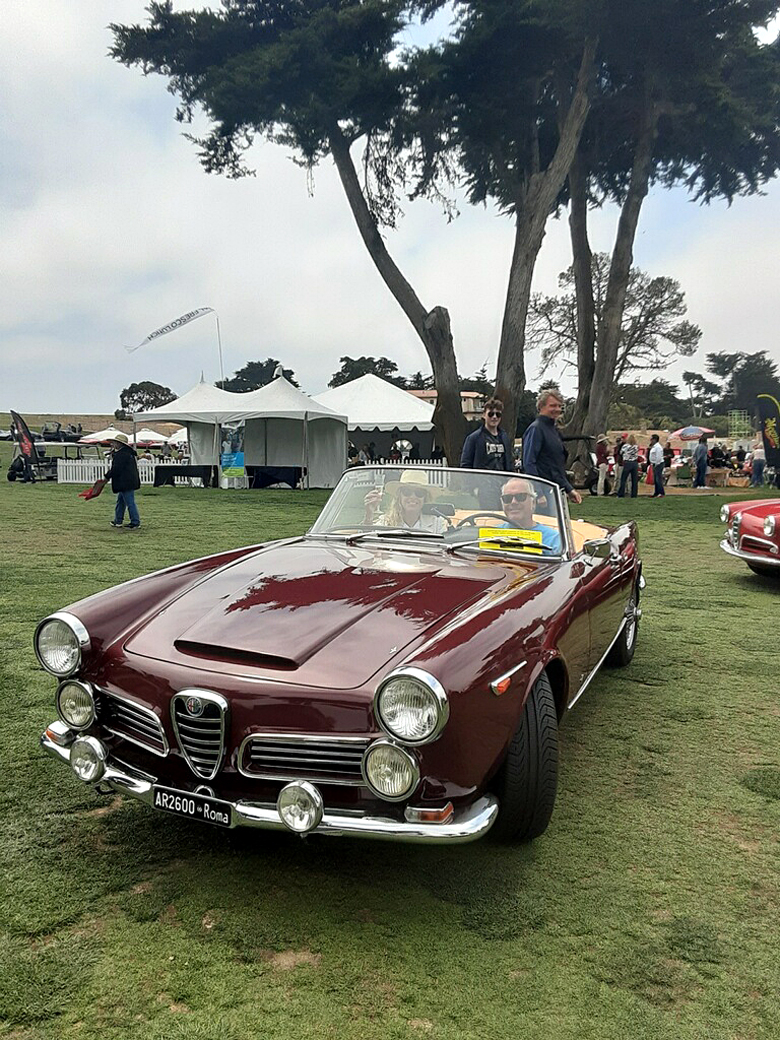
Photo courtesy Jean Pierre Legras.
Story by Brandes Elitch
To state the obvious, if you own or plan on getting an Italian car (and why not?), the Concorso Italiano should be a mandatory destination before you buy. It is located on a 36-hole golf course with a spectacular view of Monterey Bay, about a two-hour drive south of San Francisco. There is certainly nothing like it anywhere outside of Italy. I was at the first Concorso, which was 35 years ago, and I wouldn’t miss it. If you want to learn about a particular Italian car, there will be one there, and the owner will be quite pleased to show it to you and fill you in on the details. Just imagine if somehow you could attend the annual meeting of all the Italian car clubs in the country, in one day, talking to marque experts who are anxious to tell you why their favorite car is just the thing for you!
Let me start by quoting from the organizer Tom McDowell. Tom has been running the Concorso for 12 years now, and did a marvelous job of bringing it back from a somewhat unstable situation when he acquired it. “What draws us to a celebration of Italian automobiles? It isn’t just the cars. It is the music. It is art. It is style, and it is food. In short, we may call it “La Dolce Vita.” That’s why we’re here. We like the Italian influence in design, not only in cars, but of all things.” He also cautions us to bear in mind that all good Italian events must have a little chaos.
But there really isn’t any chaos here, just the opposite, because of the hard work by the volunteers and staff (a 6 person field staging team and 13 field coordinators) and the 12 individual car clubs who make it happen, including:
-Abarth Enthusiasts Worldwide
-The Alfa Romeo Association and the Alfa Romeo Owners Club
-Pantera International Car Club
-Ferrari Club of America and Ferrari Owners Club
-FIAT America
-ISO and Bizzarrini Owners Club
-Lamborghini Club America and Lamborghini Owners Club
-The American Lancia Club
-The Maserati Club, California
Given all the different clubs and the number of cars exhibited (about a thousand in past shows) it is really not chaos, but a triumph of organization just to get all the cars on the field and placed in the right spot before the show opens. There are displays honoring specific marques, such as the Lancia Lambda centennial, and the fiftieth anniversary (can it be?) of the Maserati Bora, Lamborghini Countach, and De Tomaso Pantera. Also featured were some Alfas: the Giulietta Sprints, the 2000/2600, and the Montreal.
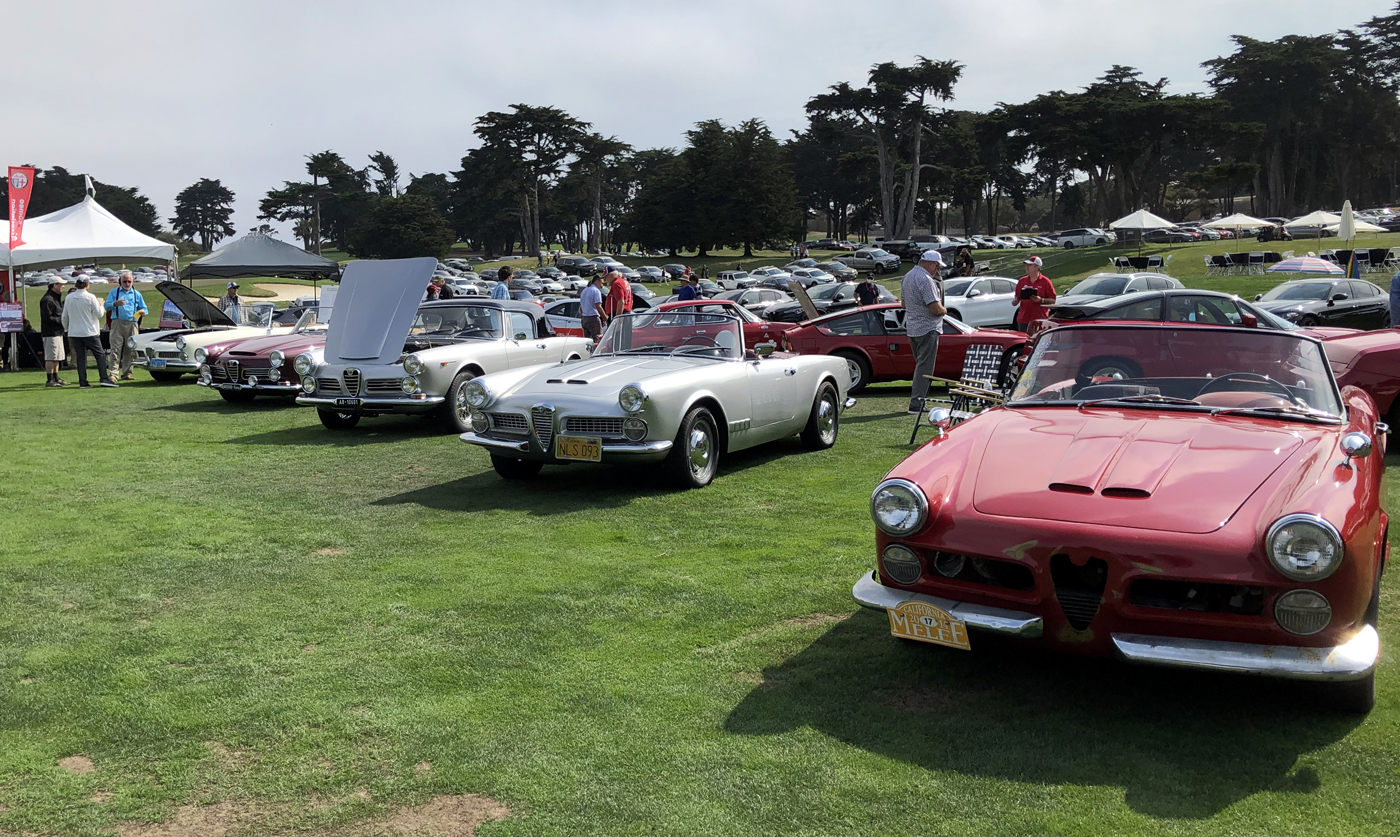
Photo courtesy Jean Pierre Legras.
Most of us will gravitate to the marque that we are most familiar with (or devoted to), but inevitably there will be a specific car that will jump out at you. In my case, I want to tell you about two that did this to me.
The first is a 1965 Alfa Romeo 2600 Spider, owned by Jean Pierre Legras, which turned out to be the winner of the Best of Show this year at the Concorso. I’ll let him tell the story.
“In 2013, I told a friend that my dream car was an Alfa 2600 Spider. He knew about one at a repair shop that had been sitting for years, with parts lost or broken or scattered about that were removed seven years earlier. After lengthy inquiries I found the owner and bought the car. The real work on the restoration began in 2015.” I should add that Jean Pierre is not inexperienced in car restoration. He learned to weld when he was nine (!) and in college worked for an uncle who had a welding and metal fabrication shop. He took classes in automotive engine building and fuel systems. After he completed his degree in Industrial Design, he worked as a crew member on a TransAm racecar team. After college, he worked for Bruce Canepa and restored vintage race cars, as well as working in the former Harrah’s Museum restoration shop in Reno.
“The previous owner had overheated the motor and the head was warped beyond repair. Many small components were missing. I discovered this was a rare engine and replacement parts were non-existent. Fortunately, via the Alfa Bulletin Board, I discovered Ian Packer in England, who had salvaged a few engines and had many parts I needed. The engine rebuild was a 3-year process.
“Concurrently, the rest of the car was completely disassembled and the body was stripped to bare metal. There was rust in the spare tire compartment. I welded in new parts I got in Scandinavia. The under-body support for the pedal assembly was rusted and I had to fabricate the metal piece myself as no part was available.
“I invested in a plating system kit from Caswell, and after bead blasting the hardware, began the replating process. The 13 mm head nuts were rust pitted, so I zinc plated them and sanded them down over and over again until the pits were filled and the surface was smooth. I did the same process with the air cleaner, which basically had to be re-fabricated.”
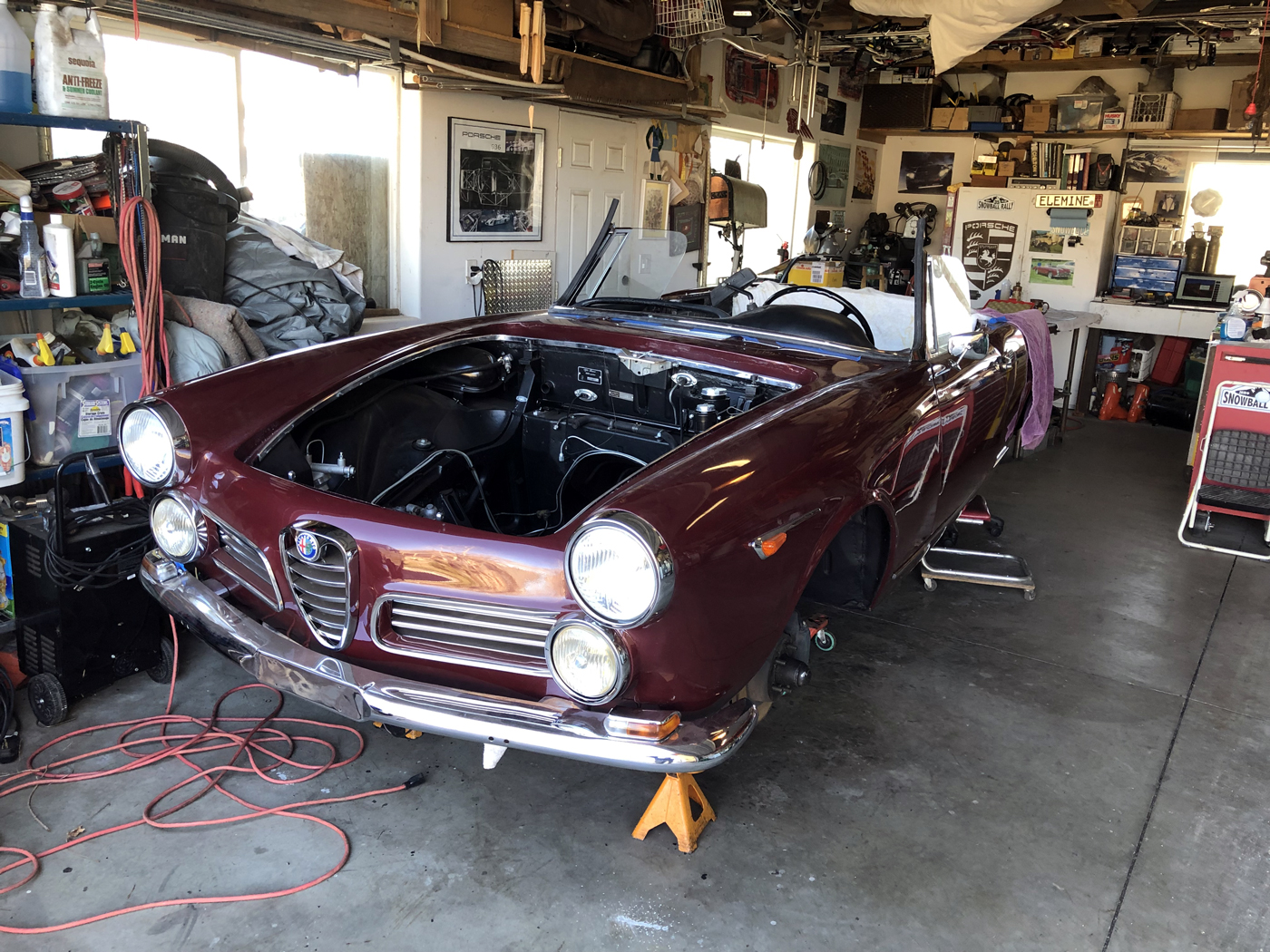
Caution, restoration in progress. Photo courtesy Jean Pierre Legras
“I rebuilt the original suspension and brakes and installed new tires and Dayton wire wheels. I researched all the colors and styles of paint and upholstery from the period and mounted a collage on my garage wall, which I studied for a long time until making a choice. I repaired the rust on a set of original Carello fog lights as the reflectors were rusted through. I found a dead Becker Europa radio and installed a new BlueTooth receiver to maintain the original look and feel.”
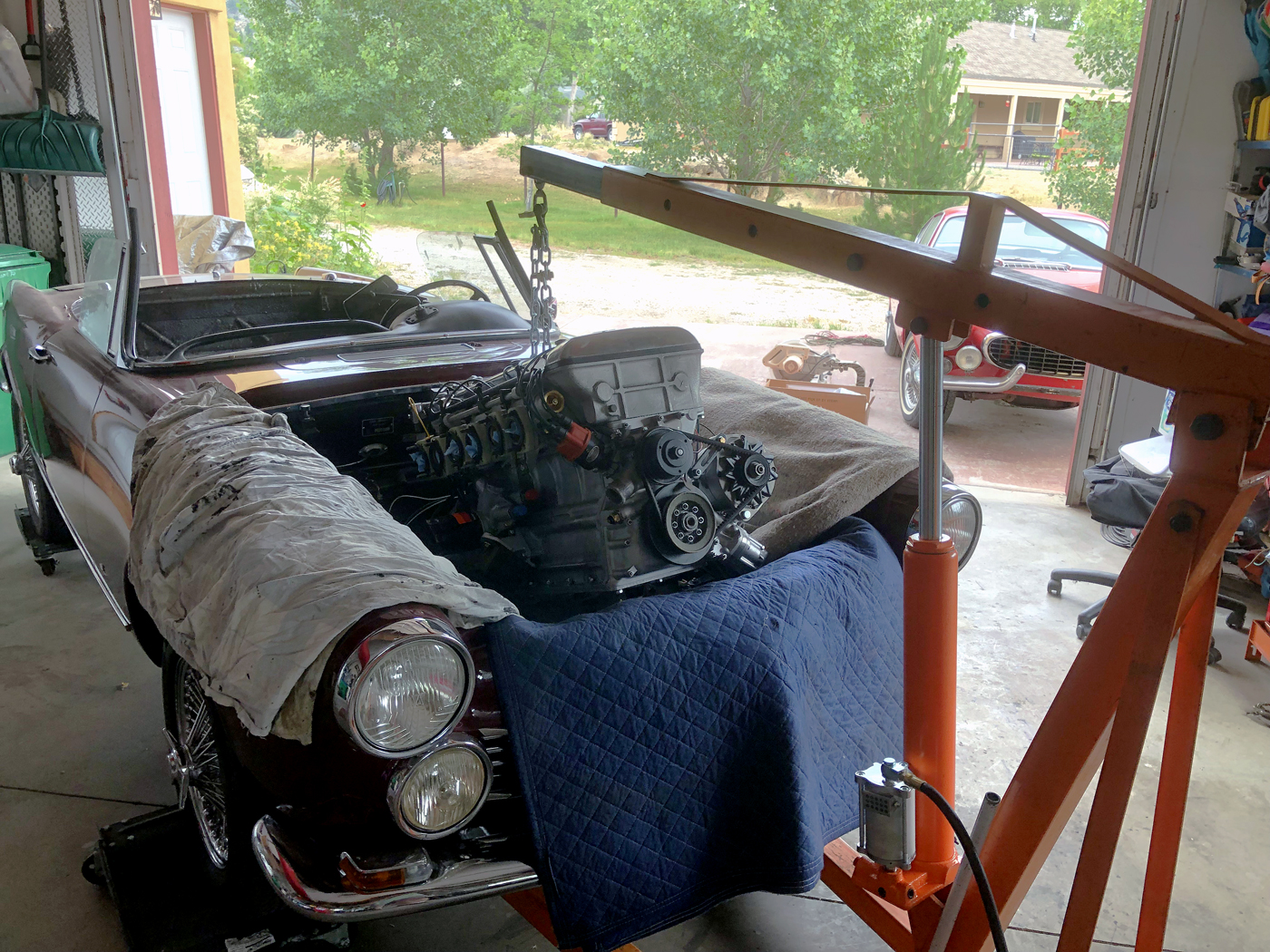
A magic moment. Photo courtesy Jean Pierre Legras
“To restore a car such as the 2600 is a privilege. A lot of car collectors regard themselves as mere caretakers of a masterpiece that will outlive them, an item to be parked and covered, driven only during the most special of occasions. This is not my view. I would compare this to saving my girlfriend for the next guy. I plan on driving and enjoying the Alfa as frequently as I can, and for as many years as she has in her.”
As an ex-Alfa owner (which means “Always Looking for Another”) here are the links to get you moving forward: www.alfaromeoassociation.org, and www.aroc-usa.org. This year, the joint club annual meeting is in Colorado Springs, in September. Put this on your calendar.
As I walked through the hundreds and hundreds of Italian cars, I wondered what I would buy today if I was in the market, with the obvious realization that I could not afford a Ferrari, Lamborghini, Maserati, or the Lancias or Alfas that interested me. With that thought in mind, I wandered over to the FIAT exhibit, where I found a delightful 1975 FIAT X-1/9 owned by Richard Kraus, of Hayward, CA. I have always admired the X-1/9 and I consider it a truly brilliant design – mid-mounted, transverse motor and transmission, and the first European car to be designed specifically to meet upcoming American safety standards. Inside the monocoque body, the fuel tank and spare wheel are located ahead of the motor, behind the seating area, directly in front of the rear axle, and there are cargo areas front and rear. The removable targa hardtop can be stored in the front compartment.
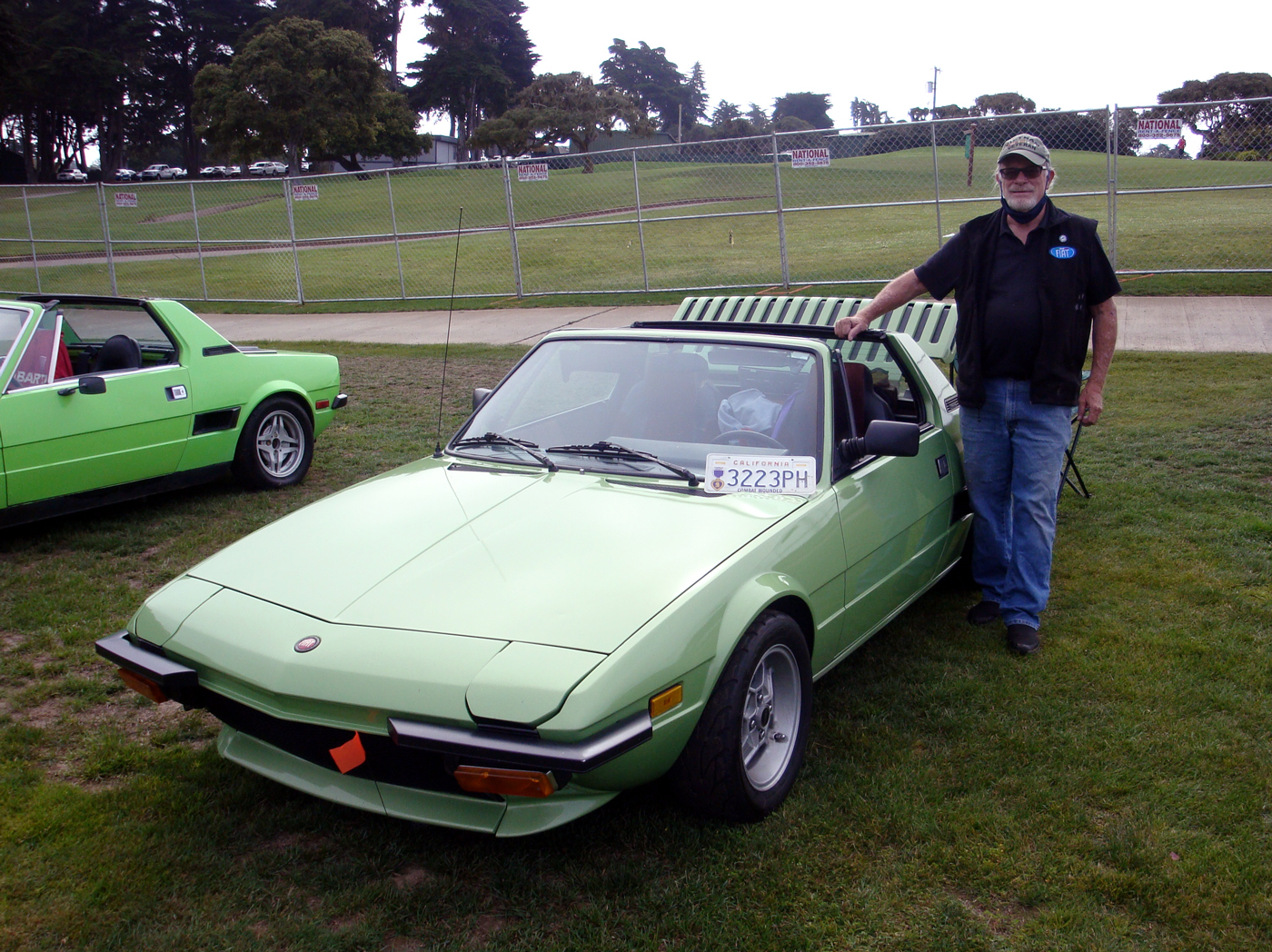
Richard Kraus and his Fiat. Brandes Elitch photo.
It was designed by Bertone (under Marcello Gandini) and manufactured by FIAT from 1972-1982, and then by Bertone themselves until 1989. The motor was designed by Aurelio Lampredi, a SOHC layout originally for the FIAT 128.
In 1982, FIAT closed down their U.S. dealer network, and marketing and support was turned over to Malcom Bricklin (!). The last year for importation was 1987, although a few were sold for a few years by M.I.K. Automotive in Los Angeles. Interestingly, about two-thirds of the total manufacture (160,000) were sold here in the states, but try finding one today, after forty years – perhaps only a few thousand are left.
Richard told me that he went to Vietnam, where he was seriously wounded after a short time in country. He was at Letterman Hospital for 7 weeks recuperating. He had time to think about what car he would get. He originally wanted a 124 but could not afford it, so he bought the X-1/9 new. He’s had had it ever since, and has been delighted with it all that time, making modifications over the last 36 years, to keep it in concours condition.
Richard Kraus and Jean Pierre Legras are typical of many Italian car owners. They have something very special, but they want to use it the way it was intended to get the maximum joy out of it, an Italian way of looking at life that we would do well to emulate.
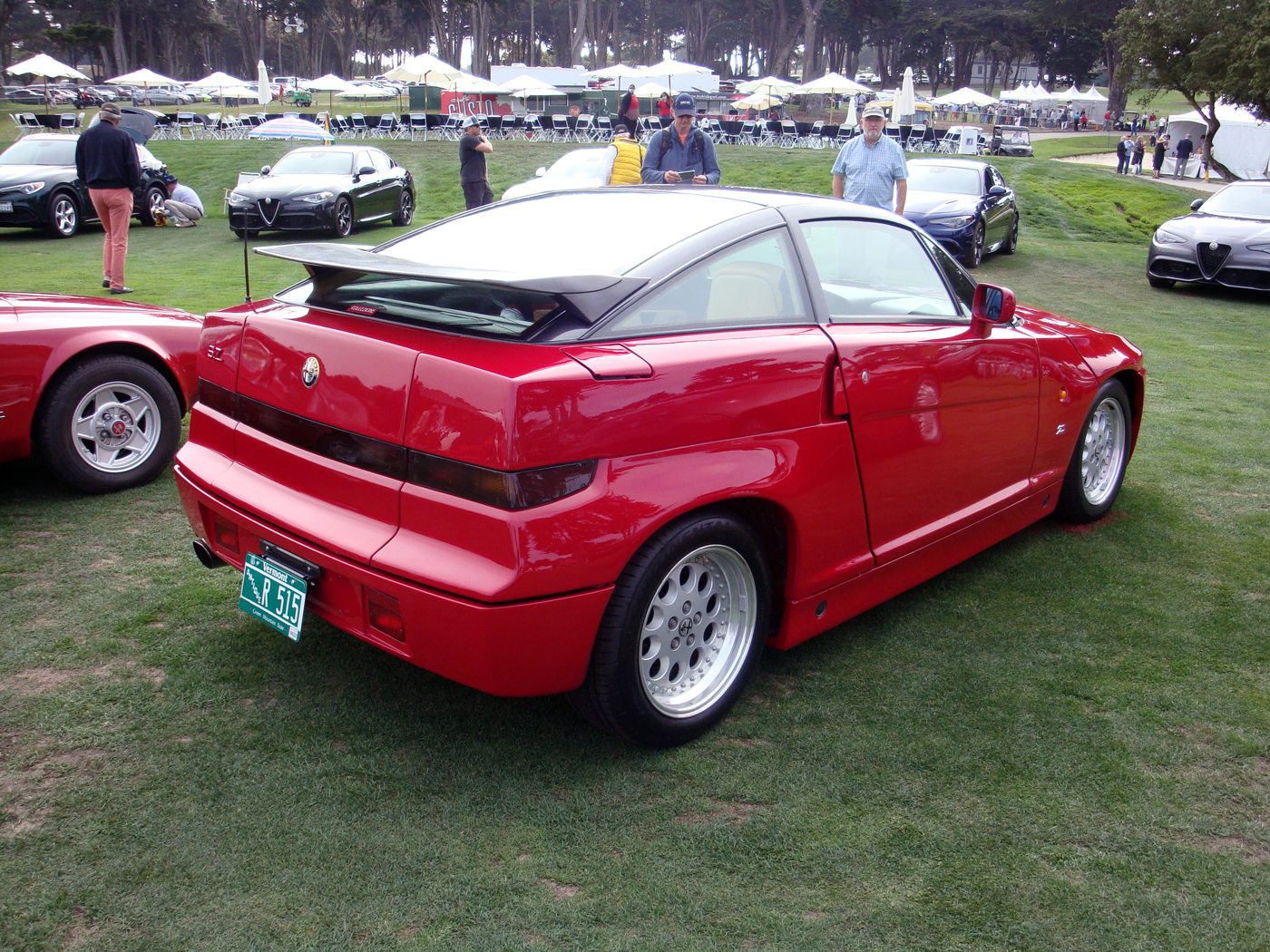
Alfa SZ grows on one over the years. Brandes Elitch photo.
Finally, in summing up the experience of owning and restoring an Italian car, here is a quote from Galileo: “Eppur, si molove!” which means, “Nevertheless, it moves!”
Yes, well in my experience, having previously owned a couple of Lancias as well as Maseratis, sometimes they move, and sometimes they don’t !!
Congratulations for being brave enough to publish “ordinary” people with the cars they restored themselves. To me, this is the essence of it and what should keep good cars alive.
Lauren’s Bugatti and Leno’s Alfas are all well and good, but anyone could own and restore one of those given enough money – after all, they just pay experts to do it, and the value of those cars is only what the next buyer can sell them for.
These guys drive their cars (that’s actually what cars are for!) and put their hearts and souls (not to mention $$s and bruised knuckles) into restoring them, and they should be heartily congratulated !
Well done!
Actually, I don’t think Jay has an Alfa!
Jay may not own an Alfa but Ralph Lauren has only one, an 8C2900B spider if got it right.
Haven’t been to Jay’s garage since Covid, but don’t ever recall seeing an Alfa. He does, however make an appearance or two at the annual Best of France & Italy event in Woodley Park, Burbank where there usually over 100 Alfa Romeo’s and 3 or 4 hundred other Italian (small bore mostly) and French cars gather.
For some reason Larry Dominique was interviewed by him, but no one of Alfa consequence in So. Cal seems to recall seeing him or anyone else from Stellantis.
We only have 300 members and around 2,000 (mostly historic) Alfa’s.
Stellantis was also conspicuously missing at the Concorso Italiano (not even a pop up or advertising) while their marques were represented by hundreds of Alfa Romeos, Fiats, Lancias. Maserati.