By Willem Oosthoek
Ferrari arrived loaded for bear at the Nürburgring in May 1956. The Scuderia was leading the five-race World Sports Car Championship at that point, with overwhelming victories to its name in the 12 Hours of Sebring [Juan Manuel Fangio/Eugenio Castellotti in a 3.5-liter, 4-cylinder 860 Monza] and the Mille Miglia [Castellotti again, in a 3.5-liter V12 290MM]. Only the season opener, the 1000 KM of Buenos Aires, had been captured by archrival Maserati, with their 3-liter, 6-cylinder 300S. The Trident’s 300S model was underpowered compared to the big Ferraris but it handled better, and the superb driving skills of Stirling Moss, ably assisted by local driver Carlos Menditeguy, had made all the difference in Argentina.
The Scuderia brought two entries of each winning model to the Ring. The 4-cylinder 860 Monzas were assigned to Fangio/Castellotti [chassis 0602M] and Alfonso de Portago/Olivier Gendebien [chassis 0628M]. The V12 290MM cars went to Luigi Musso/Maurice Trintignant [chassis 0616] and Phil Hill/Ken Wharton [chassis 0626]. With a stellar driver line-up of two previous race winners, complemented by Hill and Gendebien [second overall in Buenos Aires], as well as Musso [second overall at Sebring and third in the Mille Miglia], what could possibly go wrong!
Maserati showed up with three works cars. Two regular 300S models assigned to Moss/Jean Behra [chassis 3055, the Buenos Aires winning car] and Pietro Taruffi/ Harry Schell [chassis 3059]. Both Behra and Taruffi, former motorcycle champions, were at the peak of their racing career, as was Schell, who in 1956 put Vanwall’s name on the map as a strong Formula One contender. The third works entry was a 300S equipped with an experimental 3.5-liter, 6-cylinder engine for Cesare Perdisa/Robert Manzon [chassis 3062]. This car turned out to be disappointing in practice due to various problems, so the battle would be between four Ferraris and two Maseratis, with the fuel-injected works D-type Jaguar of Mike Hawthorn/ Desmond Titterington and the Porsche 550RS of Wolfgang von Trips/Umberto Maglioli considered possible spoilers. A pair of works DB3S Aston Martins present were considered to lack sufficient horsepower to challenge their competitors and could only hope for a high rate of attrition.
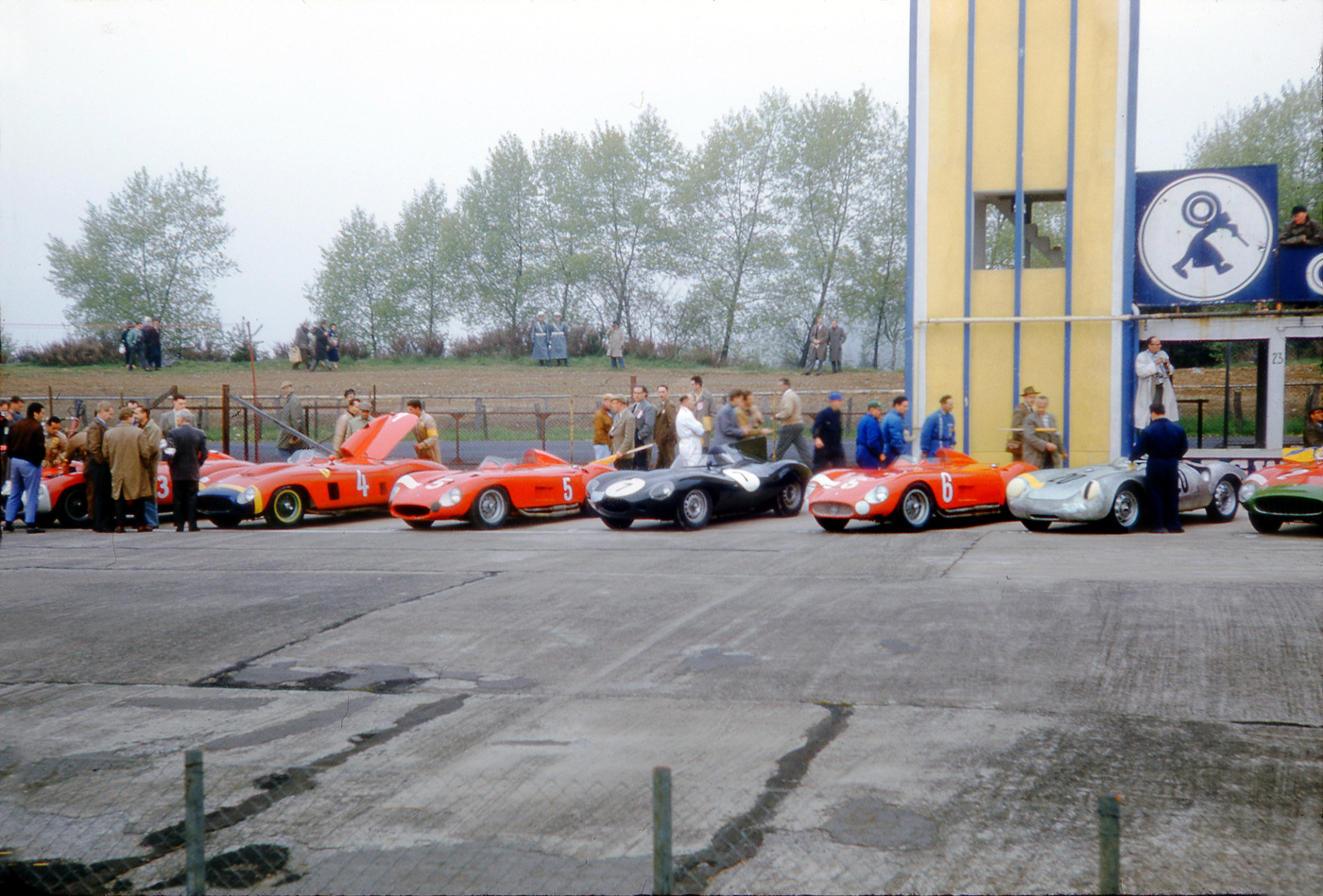
The line-up for the Le Mans start at the Ring, showing the #3 Ferrari (Musso), #4 Ferrari (Hill), #5 Maserati (Moss), #7 Jaguar (Hawthorn), #6 Maserati (Taruffi), #20 Porsche (von Trips) and #2 Ferrari (de Portago). (Photo courtesy Dave Nicholas)
Practice confirmed as much, with Fangio taking his #1 860 Monza to the head of the field in 10:03.6. He was followed by Musso [#3 290MM in 10:07.8], Hill [#4 290MM in 10:09.3], Moss [#5 300S in 10:10.8], Hawthorn [#7 D-type in 10:16.7] and Taruffi [#6 300S in 10:25.5]. Von Trips [#20 550RS] and de Portago [#2 860 Monza] qualified next, followed by the two Aston Martins.
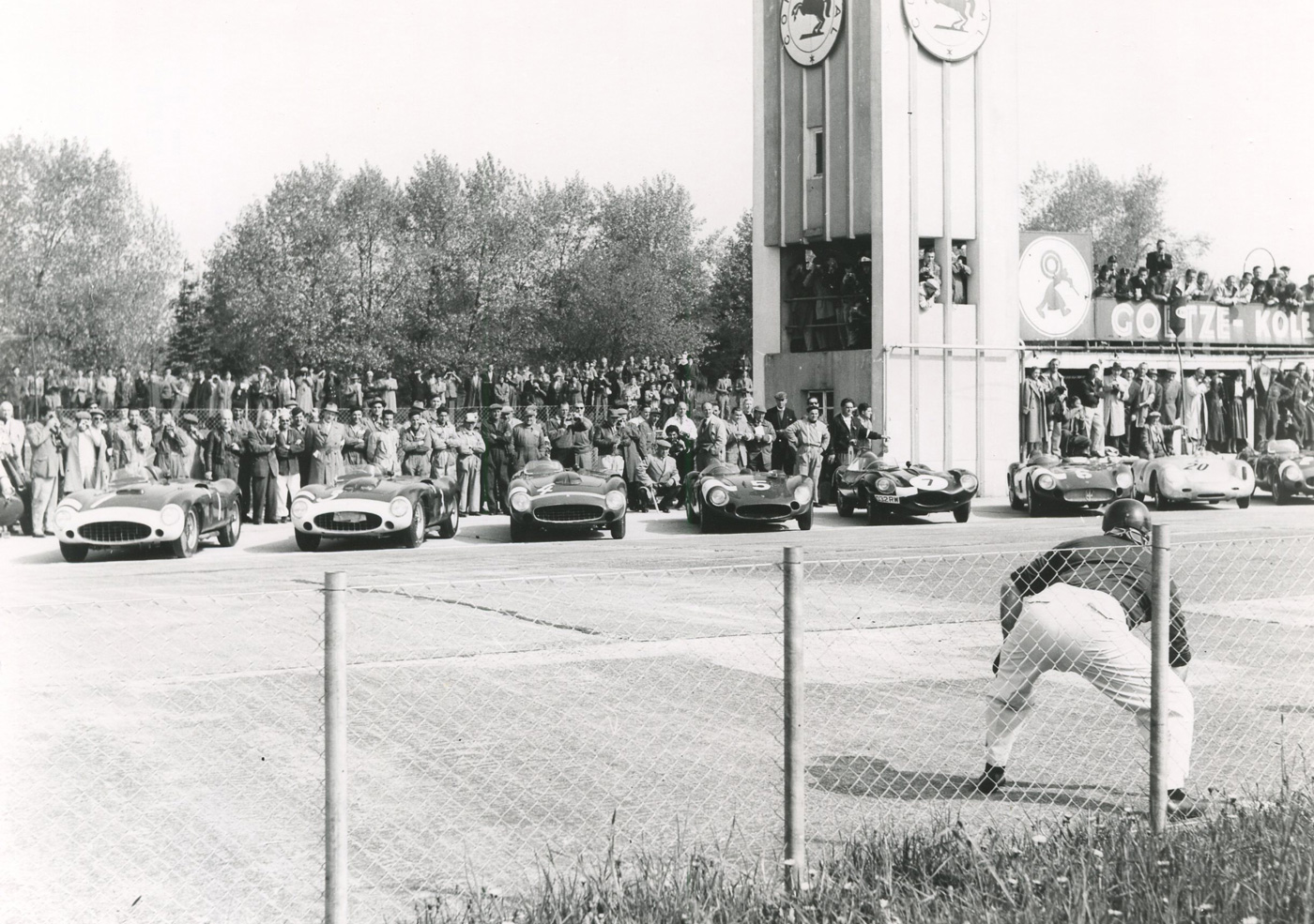
The old maestro Fangio about to start his foot race, after qualifying his Ferrari 860 Monza at the head of the line-up. (Photo by Andre van Bever)
Race day came warm and dry, unusual for the Ring. As expected, Moss beat the field at the Le Mans start, but within 100 yards Hawthorn out dragged him for the lead. Moss soon recovered and at the end of the first 14.2-mile lap [of a 44-lap race] it was Moss over Hawthorn and Fangio. Hawthorn was known for his on-and off-days, but this time he definitely had an on-day while negotiating the Ring’s 174 curves with his ill-suited, fixed rear-end D-type.
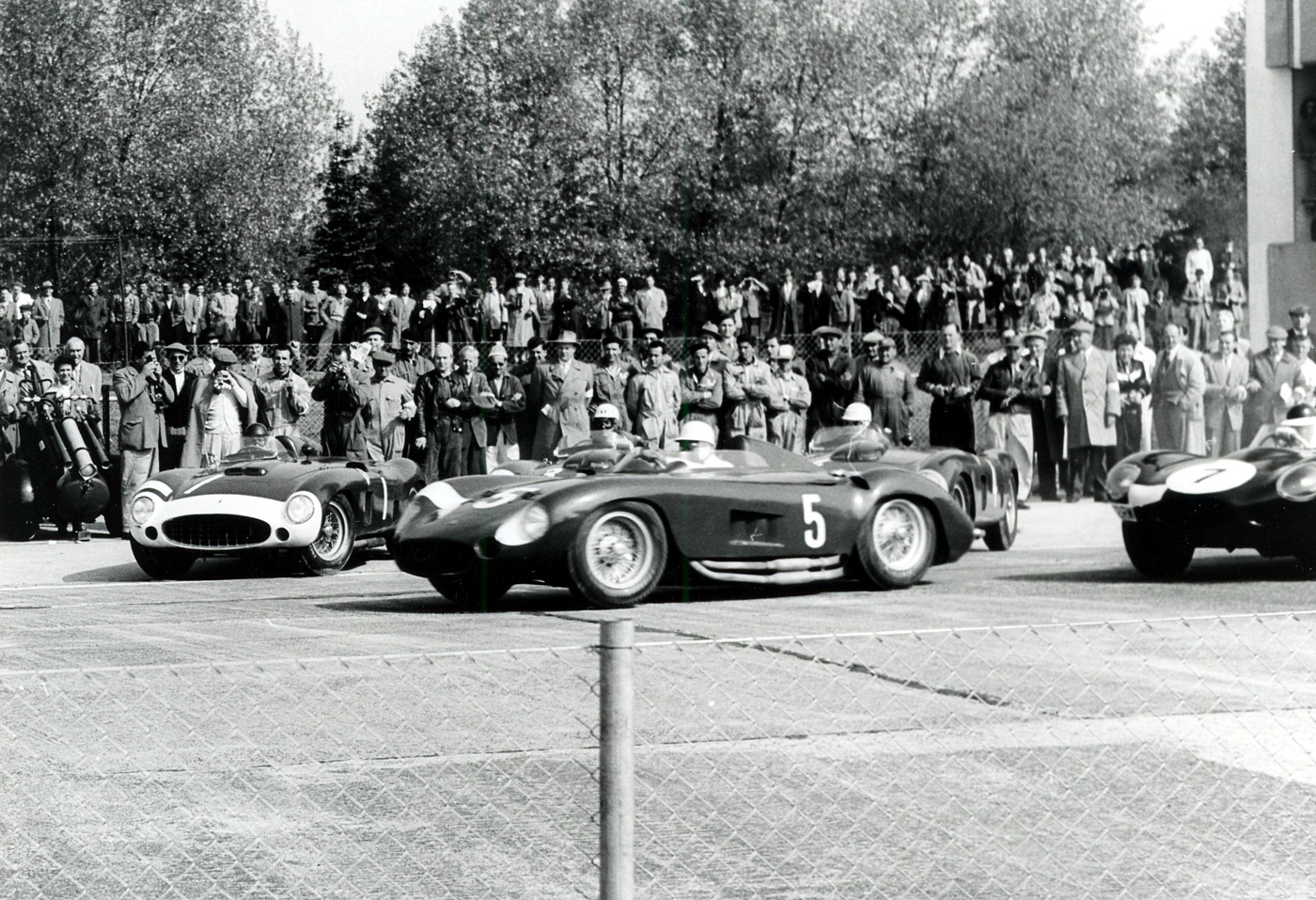
The Maserati 300S of Moss gets away first, but Hawthorn’s D-type is right behind him and would briefly take the lead. (Photo by Andre van Bever)

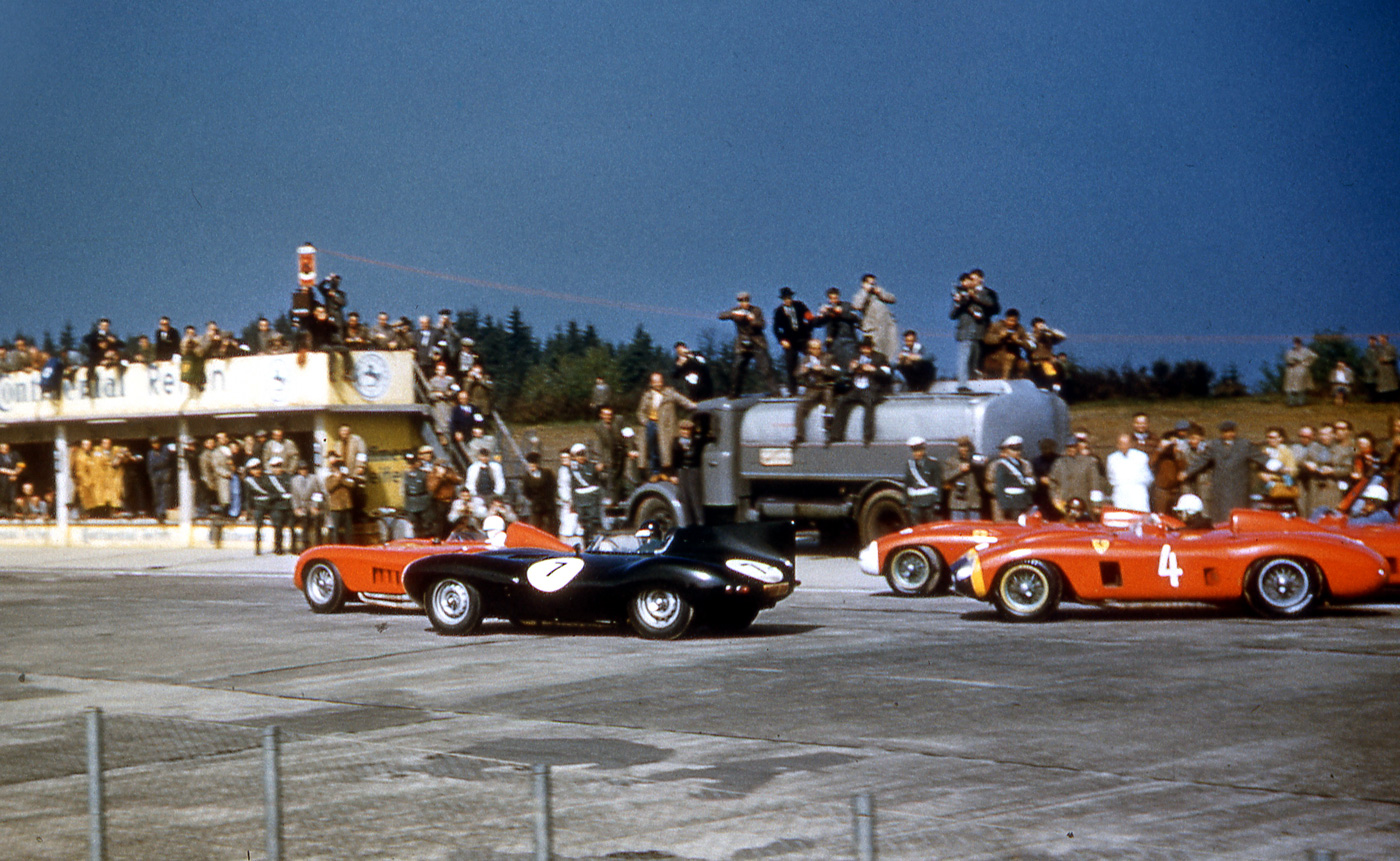
A split second later. Moss and Hawthorn lead the field, chased by Phil Hill in his #4 Ferrari 290MM. (Photo courtesy Dave Nicholas)
Ferrari’s team soon lost two of its cars. De Portago’s 860 Monza left the track at the Karussel on the opening lap and was soon disqualified, having received assistance from bystanders to rejoin the race. His Ferrari was in no shape to continue anyway, having suffered substantial nose and front fender damage, with its 4-cylinder engine severely overheating as a result. Musso crashed his 290MM on lap 4, ending upside down in a ditch. He escaped with a broken arm, which put him out of commission for the rest of the season. Maserati also lost a car, although it was not one of their front runners. The 3.5-liter 300S of Perdisa retired on lap 12 with a broken rear axle.
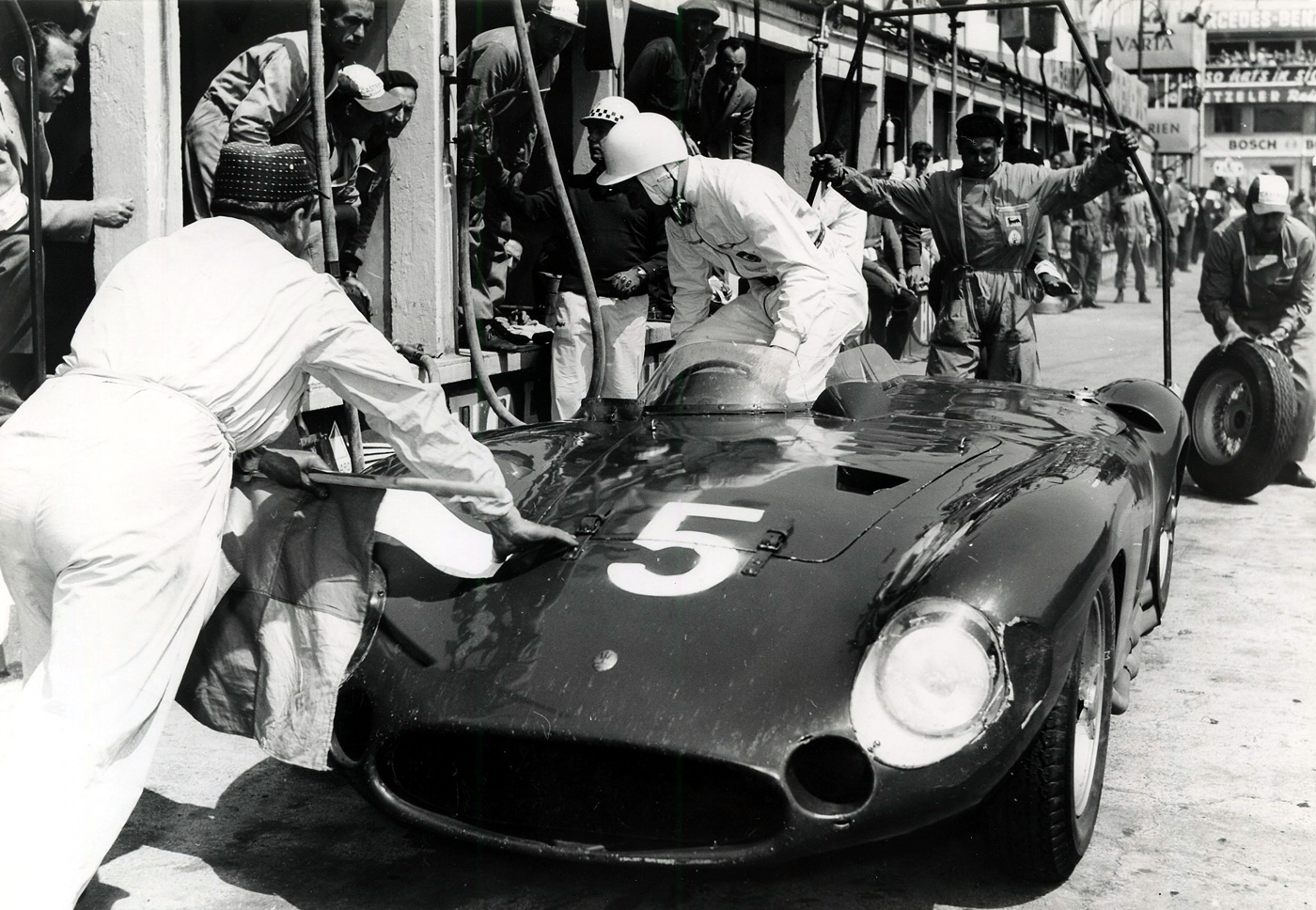
Pit stop by Moss in the leading #5 300S. Ready to take over, co-driver Jean Behra stands behind him wearing his famous checkered helmet. (Photo by Andre van Bever)
Meanwhile, Moss maintained a 15- to 20-second lead for the first 14 laps, chased in vain by Fangio who had overtaken Hawthorn. The advantage grew to 90 seconds when on lap 15 Fangio pitted for fuel and to hand over to co-driver Castellotti. Behind them came Taruffi, Hill and Hawthorn, who had been black flagged for over-enthusiastic passing and subsequently waved back into the race again. When Moss made his own pit stop on lap 16, co-driver Behra maintained the lead over Castellotti’s Ferrari. Alas, the #5 Maserati lasted only three more laps as it returned to the pit with rear suspension problems: a broken leaf spring.
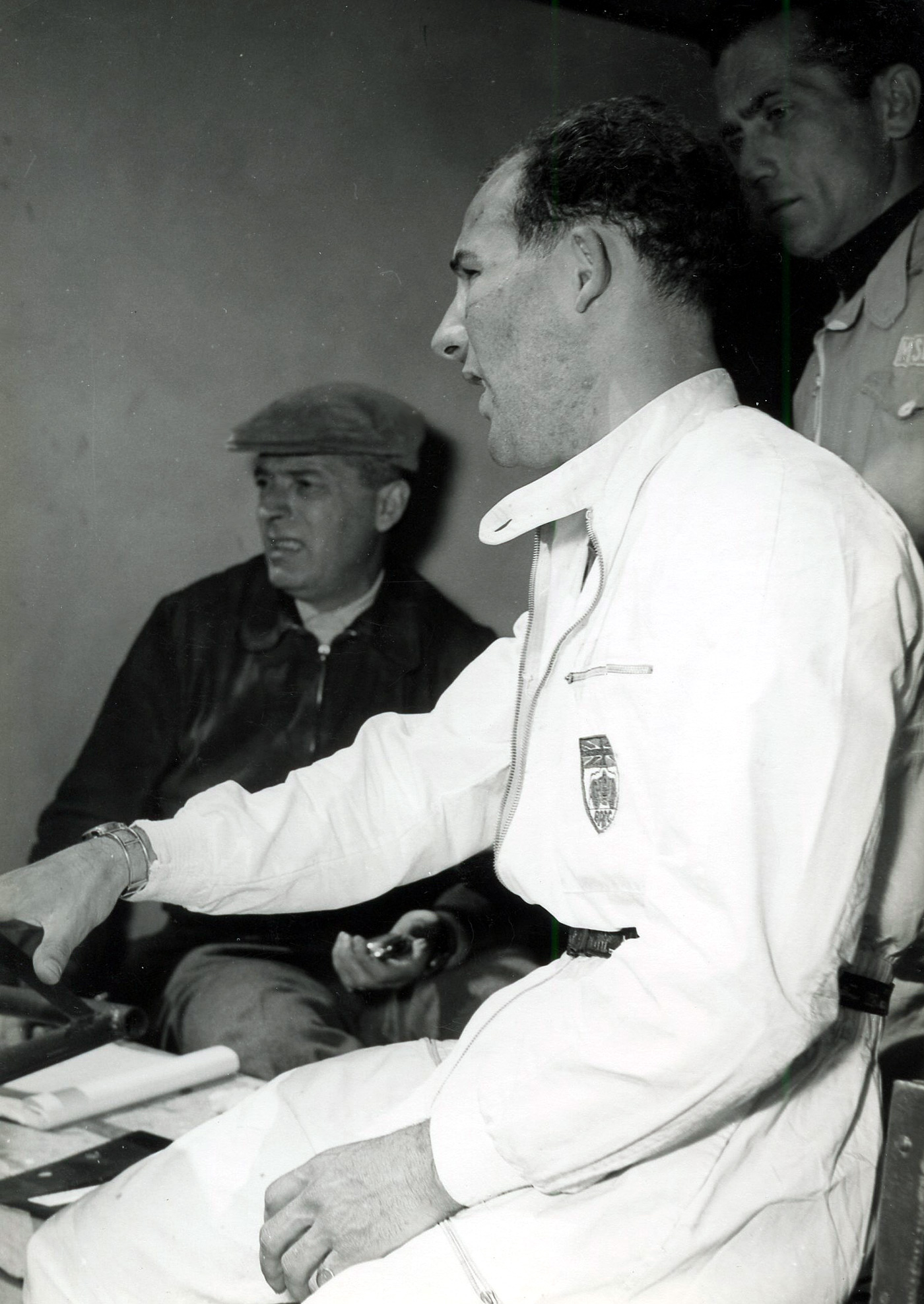
Moss and team manager Nello Ugolini, with stop watch, discuss what to do next. (Photo by Andre van Bever)
Maserati team manager Nello Ugolini made the decision to call in the third place #6 Maserati, which Schell had taken over from Taruffi four laps earlier. Behra took the wheel on lap 20 and he soon captured second place, although still behind the leading Castellotti. Behra was trailing the Italian by almost four minutes on lap 22, but he gained six to eight seconds each lap. At 31 laps, after Fangio had taken over from Castellotti again, the score was Fangio, Behra at 10 seconds, de Portago [having taken over Hill’s 290MM], Hawthorn’s D-type and Maglioli’s Porsche. With the retirements in the Ferrari camp and the resulting drivers’ shake-up, Wharton and Trintignant never got any seat time.
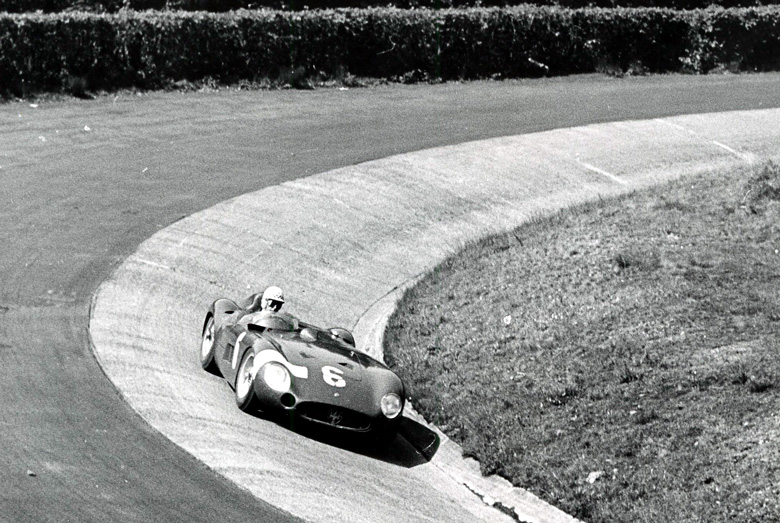
Seen in the Karussel in his chase of Fangio, Behra in the #6 300S he had taken over from teammates Taruffi and Schell. (Photo by Andre van Bever)
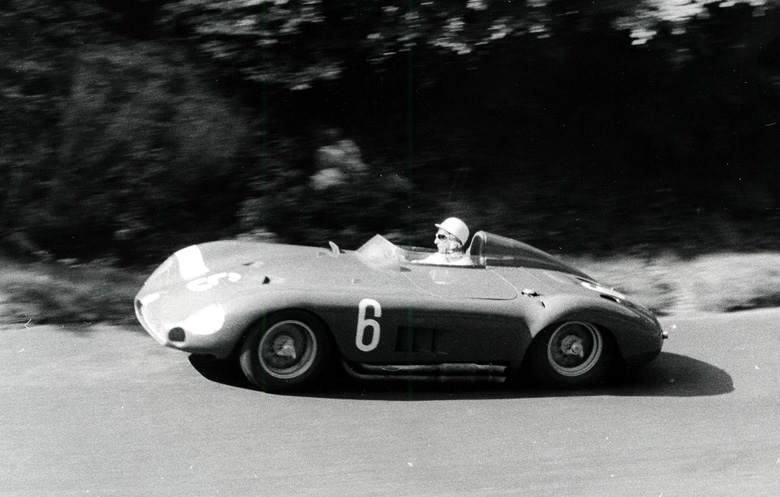
Moss did the final 12 rounds in the #6 Maserati, as he closes in on Fangio’s Ferrari which had to stop for extra fuel. (Photo by Andre van Bever)
Ugolini brought in Behra on lap 32 and Moss took the wheel, now 65 seconds behind the lead Ferrari again, but gradually gaining with each lap. Running low on fuel, Fangio was forced to pit for a quick splash-and-go on lap 40 and he lost 25 seconds. It cost him the lead and the race, as Moss flashed by, six seconds ahead while the Ferrari was still stationary. During the final four laps the Maserati only increased its lead, taking the checkered flag with 26 seconds to spare. After crossing the finish line Moss was embraced by Behra and Ugolini. The victory wreath was not big enough to cover him and his three co-drivers, so two of them were used. The elated foursome was joined by Ugolini and Maserati’s chief mechanic Guerrino Bertocchi on the winner’s podium.
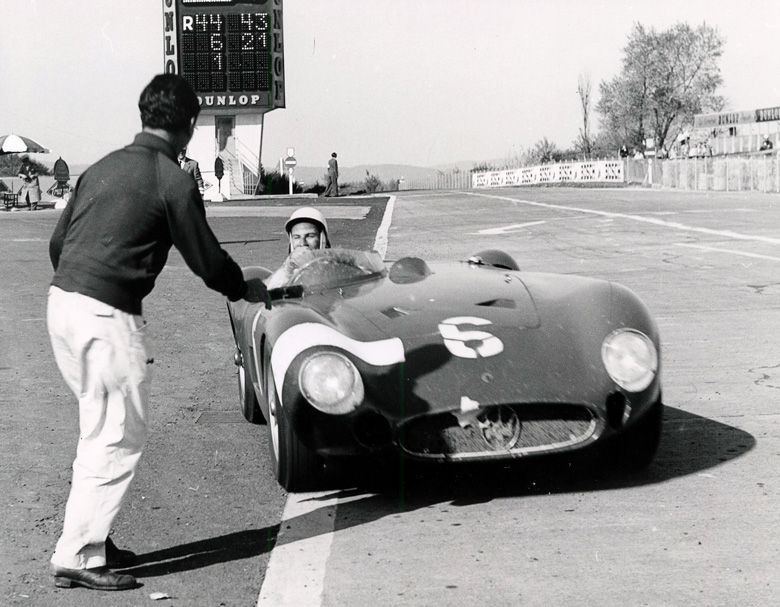
Behra greets the victorious Moss. The Dunlop score board in the background tells it all: 44 laps completed and Maserati #6 ahead of Ferrari #1. (Photo by Andre van Bever)
After the race Fangio claimed that suspension problems of his 860MM had prevented him from reeling in Moss at the end. However, during his final pitstop the Ferrari mechanics checked and could find nothing wrong. Post-race it was decided that the likely reason was incorrect pressures used on their Engelbert tires. In spite of that, Fangio did set the fastest lap earlier in the day, in 10:05.3.
When the Hawthorn/Titterington D-type, fourth overall for most of the race in spite of a loose fuel tank that had to be fixed, broke a half shaft and lost a wheel on the final lap, the top results became:
1. Maserati 300S [Taruffi/Schell/Behra/Moss]
2. Ferrari 860 Monza [Fangio/Castellotti]
3. Ferrari 290MM [Hill/de Portago/Gendebien]
4. Porsche 550RS [von Trips/Maglioli]
All completed 44 laps. It took the winning Maserati 7 hours, 43 minutes and 54.5 seconds [an average of 80.658 mph] to reach the finish.
By all accounts, this was a remarkable performance by Behra and Moss. In his book Stirling Moss, My Cars, My Career, the Englishman described his opinion of the Maserati 300S. “There really was something about the 300S and me. We seemed to be made for each other.” Moss raced the model in 16 events, giving him nine wins, three second places, a third, a fifth and only two DNFs. “A decently prepared 300S had a chassis which was infinitely superior to any front-engined sports Ferrari and although it lacked their wonderfully smooth and powerful V12 engine, its 6-cylinder was always man enough for the job.’
Now Ferrari and Maserati had two victories each in their chase for the 1956 World Sports Car Championship. With Le Mans not part of the series that year, the next event, the Swedish Grand Prix at Kristianstad in August, would decide the winning marque. Although Moss qualified fastest in his 300S, the race turned out a disaster for the five works Maseratis entered. A collision, a pit stop fire and three mechanical breakdowns decimated the team. As a result, at the finish Ferrari claimed the first five spots to win the 1956 Championship.
Fantastic stuff as usual from Willem ! Nothing in racing today compares to these individuals or vehicles.
Another interest article from Willem! Great photos of great cars and great people.
This is me Present again at this race, as I was at the time of the original race, visiting fellow Army Brats overseas. Willem is Exceptional at developing the “story”. We are caught up in the living web created by this writer’s magic replay narrative. Deja Vu all over again! Thank You, Willem, Ever so Much!!!!! Va Bene Mi amigo !!!!! Walt
wonderful photos !!
Thank you, Willem, for a great article in which everything that had to be written was included. The race, that I attended and was my first visit to the Nürburgring, showed the absolute mastery of Stirling Moss and the handling superiority of his Maserati 300 S.
Keep up the good work !
I loved the article as well, and the included photographs are spectacular!
Great drama from Willem.
If you’re interested in the contests between these great marques from the thirties to 1966 and the men and machines involved I can recommend “Red-Hot Rivals” by yours truly. It’s been reviewed by Veloce Today so you can see what they made of it.
Readily available from Amazon.