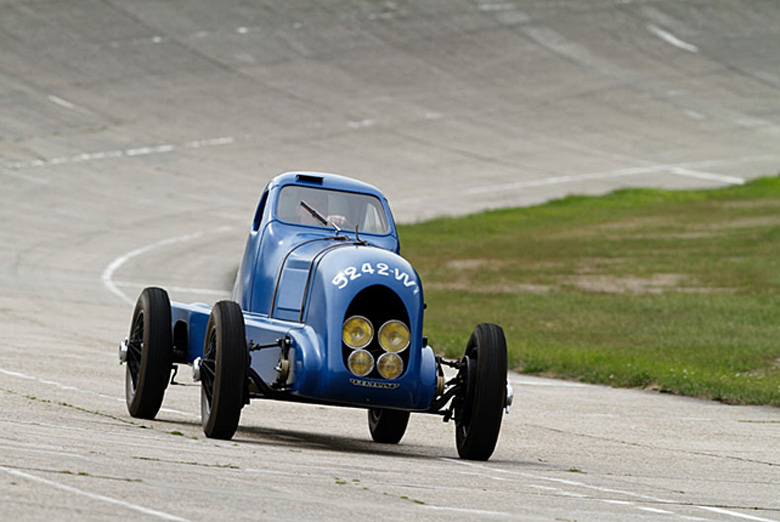
1934 Nervasport des Records.
By Gijsbert-Paul Berk
All photos courtesy Renault Communications
This week Berk looks at the 1934 Renault record car and the 1956 turbine-powered Renault called the Shooting Star.
1934 Nervasport des Records
The background story of the 1934 Nervasport des Records shows a similarity with that of its predecessor the 40 CV Type NM. During the early nineteen-thirties the sales of the Nervasport, then the top model of the Renault range, needed a boost. The French economy passed through a difficult time and demand for the more expensive models had drastically declined. Therefore, Louis Renault decided to repeat what he had done in 1925 /1926 by building a car that could establish new speed/endurance records and demonstrate the advanced technology of his company.
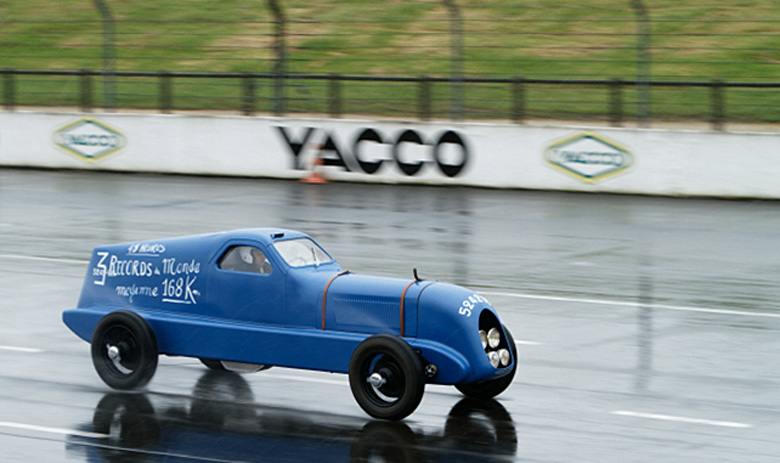
The shape of the Nervasport single seater body of the Nervasport des Records clearly shows the aviation influence.
He engaged the services of Marcel Riffard, the brilliant chief engineer of Caudron, a French aircraft manufacturer. Renault even bought the Caudron factory to be assured of the collaboration of Riffard, who had designed several record setting air planes. The shape of the single seater body of the Nervasport des Records clearly shows the aviation influence. It looks like a fuselage without wings. The mechanical components of the record car came from the parts bin of the Nervasport production cars. It had a water-cooled front mounted eight-in-line flathead engine with a capacity of 4.825 liters driving the rear wheels, through a three speed gearbox. Thanks to its good aerodynamics it could reach just over 200 km/h.
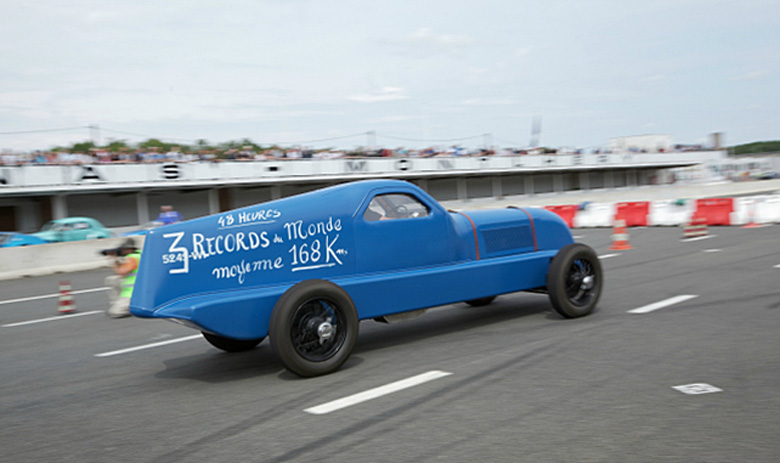
The fate of the original 1934 Nervasport des Records is clouded in mystery, and this is a reconstruction.
On April 5, 1934, the drivers Roger Quatresous, Louis Fromentin, André Wagner and Georges Berthelon, headed by Auguste Riolfo, head of Renault’s test department, started their record attempt. After 48 hours, 3 minutes and 14 seconds the Nervasport team had broken nine international records and three world records. The most important record was the one of 8,037 km in 48 hours, which means an average of 167.445 km/h.
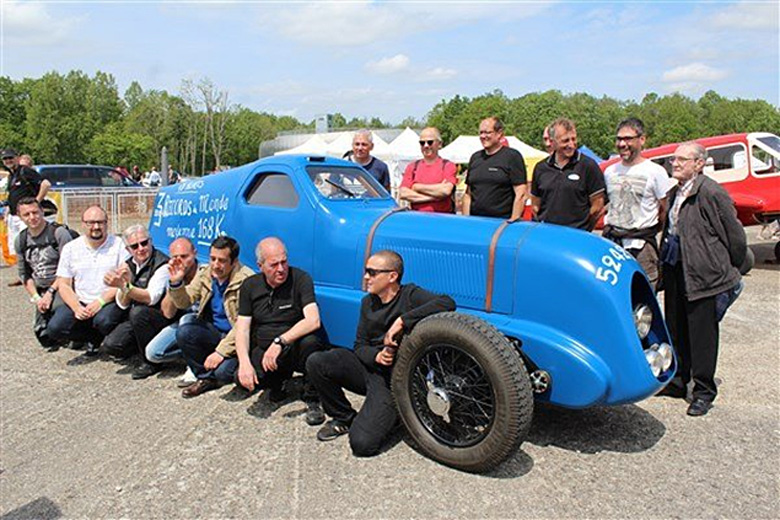
The proud team of the Renault Classic association responsible for the recreation of the 1934 Nervasport des Records.
Just like the 1929 Renault 40 CV Type NM1929, the fate of the original 1934 Nervasport des Records is clouded in mystery. Both cars were probably scrapped or destroyed by wartime bombing. However, a team of engineers and mechanics from Renault Classic, an organization of enthusiasts, has made a perfect reconstruction, with the result that the unique historic record beater could be seen and heard again at Montlhéry.
Some twenty years later in the mid-1950s, Renault was again in the record business, but with a very different approach.
1956 Etoile Filante
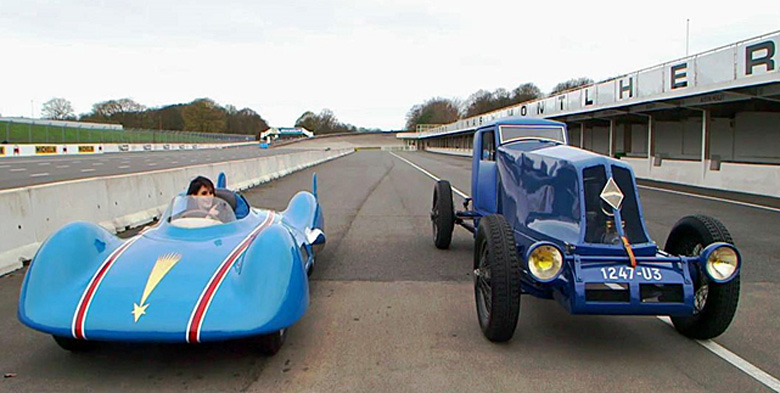
30 years of evolution and progress in record car design. The 1926 Renault 40 CV Type NM (right) could reach just over 200 km/h and ran 24 hours on the Montlhéry oval with an average speed of 173,649 km/h. The 1956 Etoile Filante (left) set the record for gas turbine powered cars at 307.4 km/h on the Bonneville Salt Flats in Utah, USA.
Nearly sixty years ago, on September 5, 1956 Jean Hébert, a French engineer and test driver, set the world speed record for turbine-powered cars on the Bonneville Salt Flats in Utah, U.S.A. at 307.4 km/h (191.0 mph). The record still stands. But the Etoile Filante (French for “shooting star”) shown here is not the original record machine, because that caught fire and was badly damaged after the record attempt. It is probably its twin sister, built simultaneously as a test bed and demonstrator.
Renault’s Bonneville adventure started in 1954 when Joseph Szydlowski, CEO of Turboméca, the French aeronautical turbine’s manufacturer, proposed to Renault CEO Pierre Lefaucheux CEO that their companies should join efforts to develop a gas turbine car, in order to gain experience with this technology and to claim the speed record for gas turbine cars.
Lefaucheux liked the challenge and appointed Fernand Picard, chief of Renault’s R&D department and Albert Lory, a famous engineer who had designed racing cars for Delage as well as the CFA Arsenal, to head the project team. Jean Hébert, a 29 years old keen engineer became responsible for all testing. The Etoile Filante is more or less constructed around the Turboméca gas turbine, which was originally intended for use in helicopters. This engine developed 270 bhp at 28,000 rpm. The transmission reduced this to 2,500 rpm. The shape of the polyester body was developed in a wind tunnel. It had two large aircraft-like fins for directional stability, and covered a space frame made up from chrome-molybdenum steel tubes.
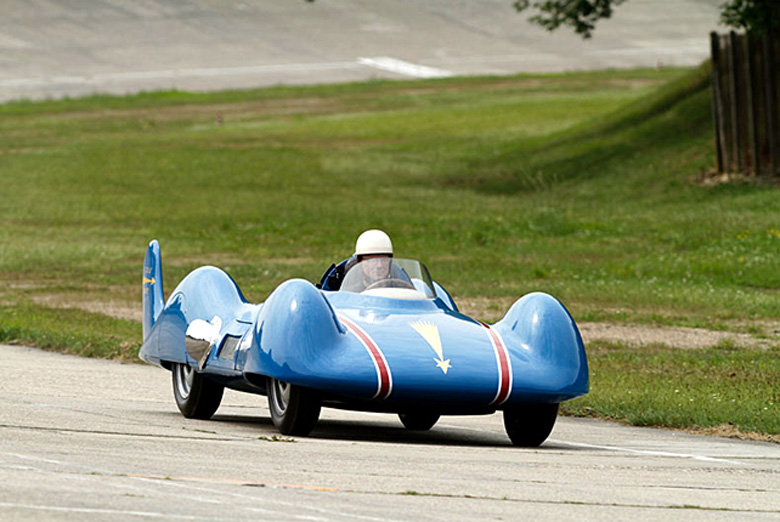
1956 Etoile Filante.
The car is 4 m 84 long, 1 m 82 wide and only 1 m 10 high. The task group that built the Etoile Filante had one single objective; to achieve the highest possible speed. The only component that eventually found its way into Renault’s production cars was the Transfluide transmission, which later became available in some Frégate models. But apart from the world wide publicity of the successful record runs, the Etoile Filante provided Renault with a unique opportunity to study the road behavior of a vehicle weighing only 950 kg when travelling at a speed of over 300 km/h. as well as the effect of fins on directional stability.
For the full story, read Renault Streamliner Hits 190mph
The Shooting Star was back at Bonneville this August, display only, and made for some fantastic pictures.