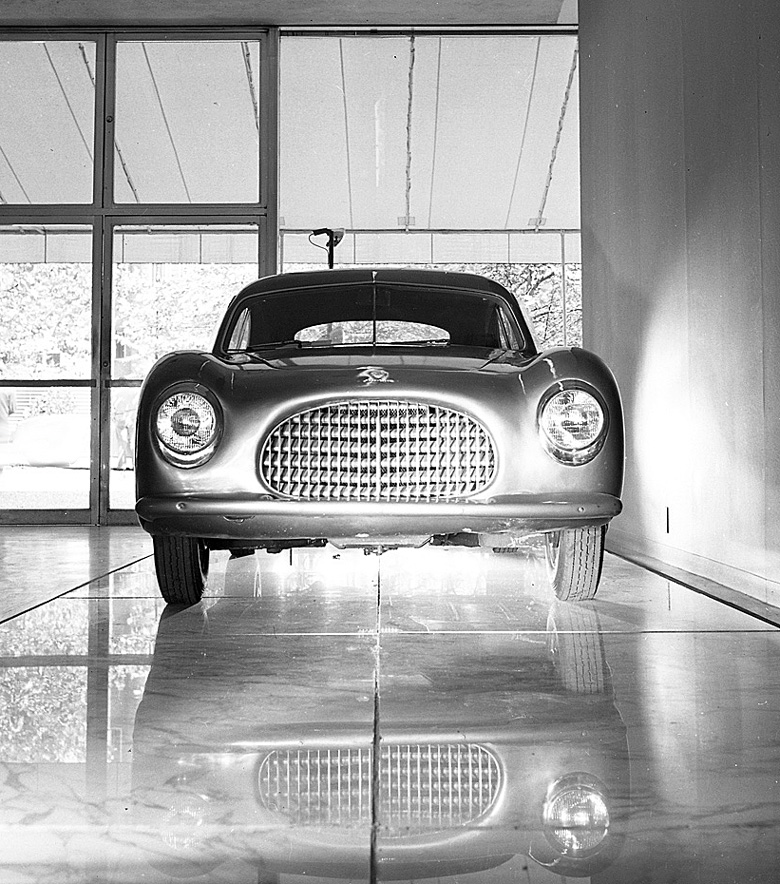
Savonuzzi’s role in the design of the Cisitalia 202 was significant but unheralded. The Cisitalia 202 at the New York Museum of Modern Art. Photo by Jerry Lehrer.
From the VeloceToday Archives, March, 2011
By Pete Vack
During a career that spanned all facets of automobile design, mechanical innovations and inventive research, Giovanni Savonuzzi was not only a superb stylist but also a brilliant engineer – a rare combination of technical prowess and design artistry fused by his training in aeronautics.
His accomplishments are legion but not yet legendary. Responsible for the most heralded and iconic of all postwar Italian designs, the Cisitalia 202 coupe of 1947, he also engineered record breaking outboard motors, highly advance midget racers, created a series of Grand Touring cars for Ford Motor company, used wind tunnel research to craft the Savonuzzi Aerodynamica and the stunning Gilda showcar, contributed immensely to the Chrysler Turbine project, and finally with Fiat, promoted and designed electric and energy efficient cars for everyday use. A remarkable career of a remarkable man whose accomplishments we are just beginning to realize.
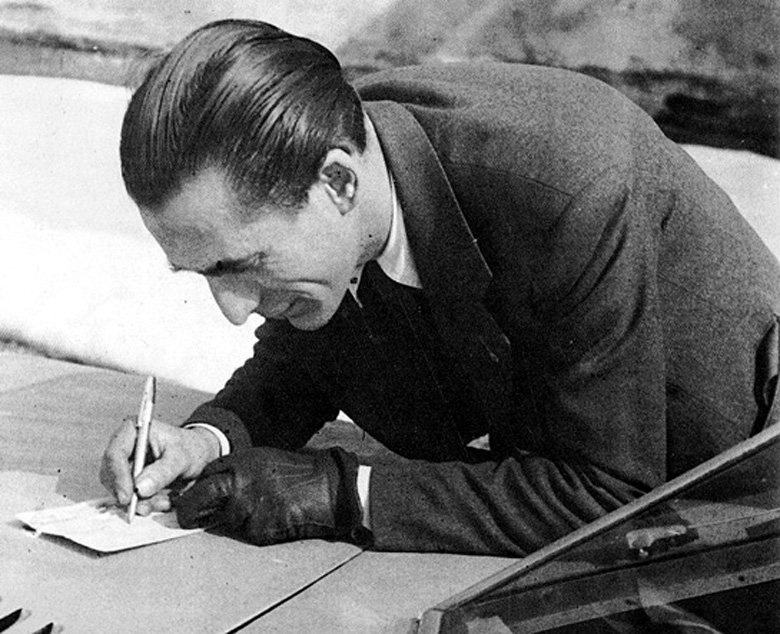
Savonuzzi at his drawing board. He was equally at home with styling and engineering.
Savonuzzi was born in Ferrara, Italy on January 28, 1911. Ferrara epitomizes that fusion of elegance in the arts and innovation in the sciences that defined the civilization of the Italian Renaissance. A man of genius, he was defined by his background, his upbringing and the imperative concept of noblesse oblige. He was therefore incapable of bragging about his accomplishments or playing the politics that are so necessary in a corporate environment.
One of the things that historian Piero Casucci noted about Savonuzzi during a lengthy interview was that “…he rarely feels disposed to speak of himself, as if what he has achieved is the most natural thing in the world; he only thanks God and humanity for having been able to express himself freely at the service of all men, pursuing just one goal: to materialize in some way, the supreme need to make and create”. 1
In 1939, Savonuzzi graduated with a degree in Industrial Mechanical Engineering from the Polytechnic of Torino and, after becoming Assistant Professor of Aeronautics and Applied Mechanics at the University, went to work in the Aviation Motor Department at FIAT. During the war, he served in Albania in the Italian Army as a Captain and distinguished himself as a leader of the partisan resistance, collaborating with the U.S. liberation forces. He was awarded citations from Major General William Donovan of the O.S.S. and General Mark Clark, whose Fifth Army secured the Italian peninsula for the Allies.
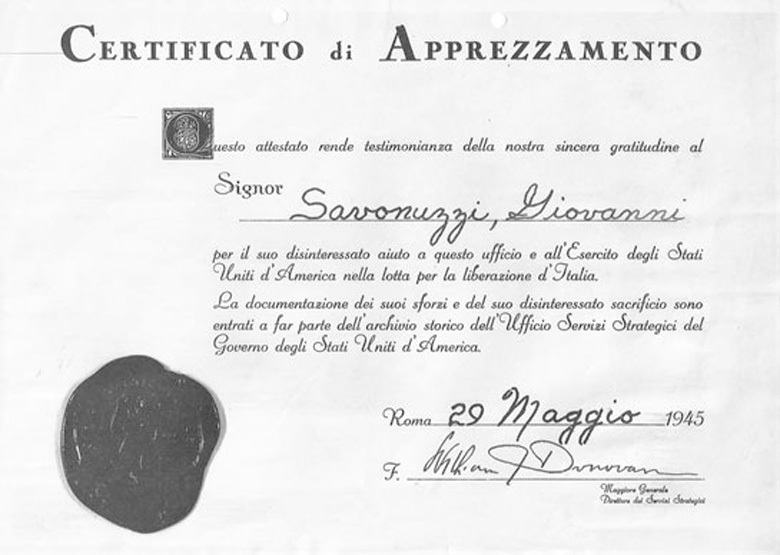
From William Donovan, then head of the OSS. It reads ‘This certificate testifies of our sincere gratitude to Giovanni Savonuzzi for his selfless service in the United States Army for the struggle for the liberation of Italy.’ The documentation of his selfless efforts and sacrifice has become part of the historical archives of the Office of Strategic Services of the U.S. government.
Origins of an Icon
From 1945 to 1948 he became Director of Cisitalia, brought in by the famous Ing. Dante Giacosa to replace him (Giacosa was to return to Fiat). According to Giacosa, Savonuzzi “…played a decisive part in perfecting the single seater prototypes and subsequently also the completion of the two seater version, after I had to give up my consultancy work for Cisitalia.” 2 In three short years, Savonuzzi completed Giacosa’s project of the D46 race car, designed the Spider Nuvolari, the Cisitalia Chassis 001CMM today known as the “Aerodynamica Savonuzzi” that remains the ultimate application of his background in aeronautics. (The 1986 FIAT wind tunnel trials confirmed with mind boggling results of a Cd of .029.) And, he invented the free-flow exhaust system that launched the career of Carlo Abarth.
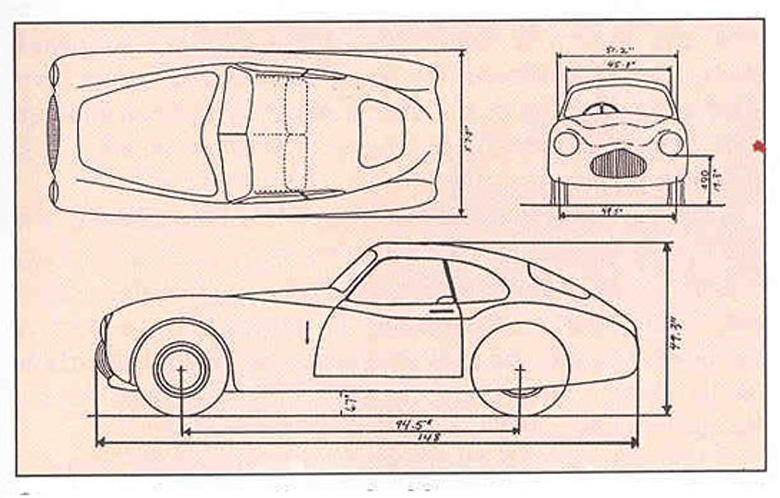
Savonuzzi’s first sketch of the proposed Cisitalia GT car. This was the design submitted to Pinin Farina in 1947.
As can be easily seen by the sketches, the ground-breaking museum-hopping declaration of the pure post war Italian line, the Cisitalia 202 coupe was essentially Savonuzzi’s creation. Various coachbuilders were approached about the 202 project, but it was Pinin Farina who got the job of converting Savonuzzi’s sketches of what is widely regarded as the most successful shape of all times, culminating in its exhibition as a sculpture in motion in the New York Museum of Modern Art.
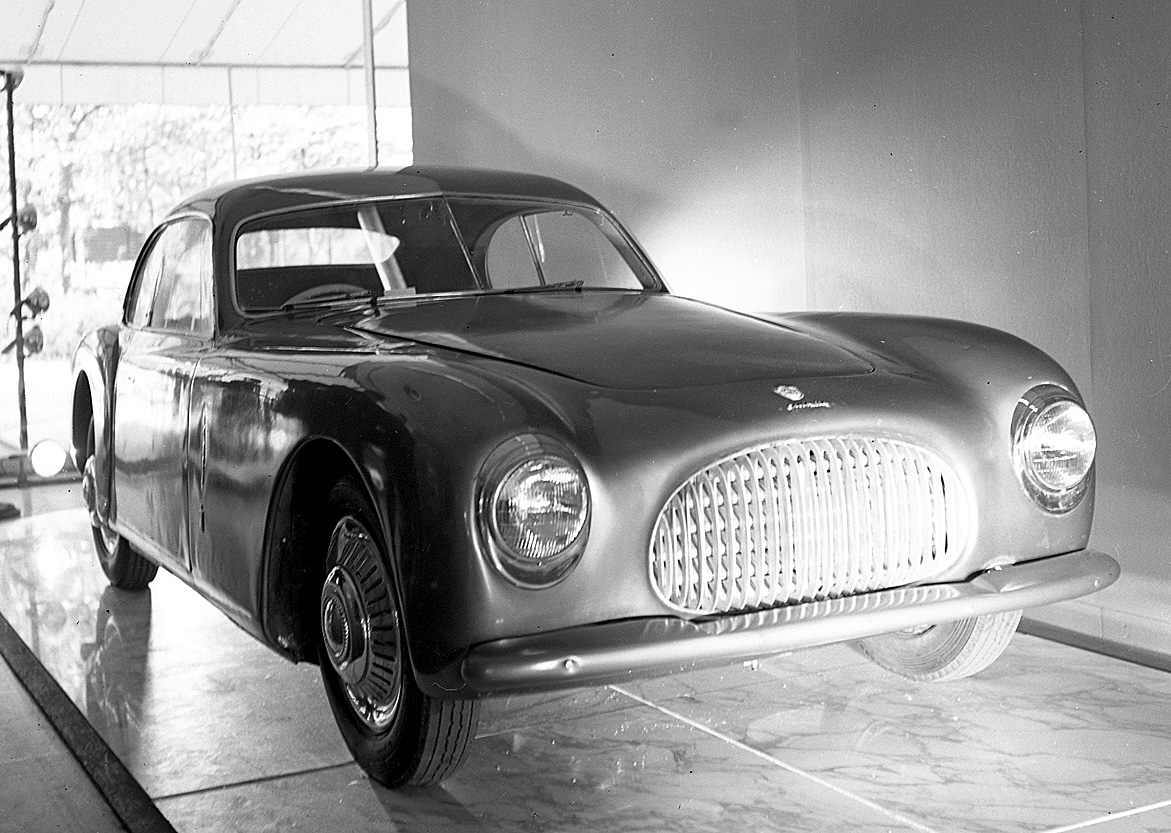
Pinin Farina’s realization of Savonuzzi’s sketches closely followed the original sketches. This is the 202 as it appeared at the New York Museum of Modern Art. Photo by Jerry Lehrer.
While the Cisitalia 202 came from the pen of his desk, he was the first to give credit to Pinin Farina for taking his concept and streamlining it into what many refer to as the most important design of the 20th century. At Cisitalia, Savonuzzi not only designed the mechanics, styled the bodywork and supervised the construction, but he did all the test-driving himself!
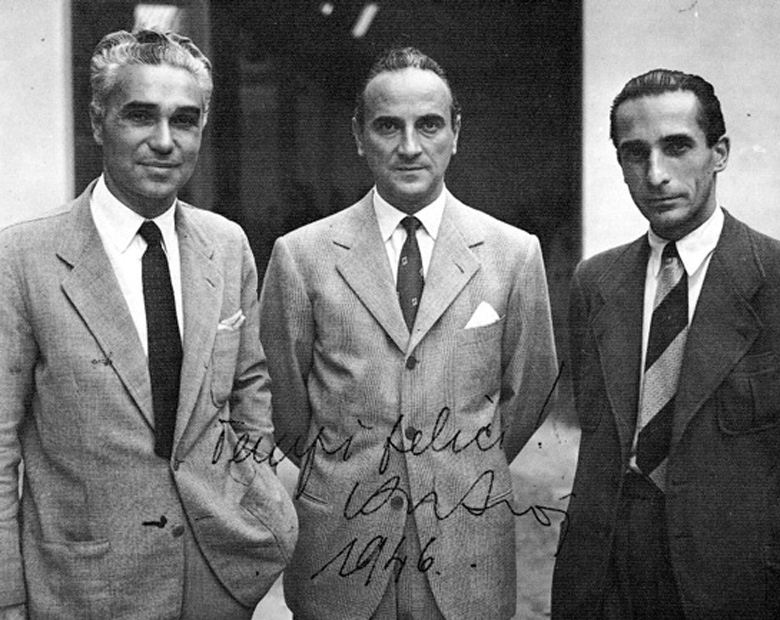
Glory days at Cisitalia: Piero Taruffi, left, Piero Dusio and Savonuzzi at right.
Cisitalia remained an indelible adventure in Savonuzzi’s memory forty years later when he recounted, “We began with wild enthusiasm. The war had just ended and there was the will to rebuild, and everyone liked the idea to build fast sports cars. I remember being awake and on my feet for 72 hours straight: the results were seen beginning with the Coppa Brezzi…with the 1947 Mille Miglia and the legendary enterprise of Nuvolari”. 3
Leaving Cisitalia
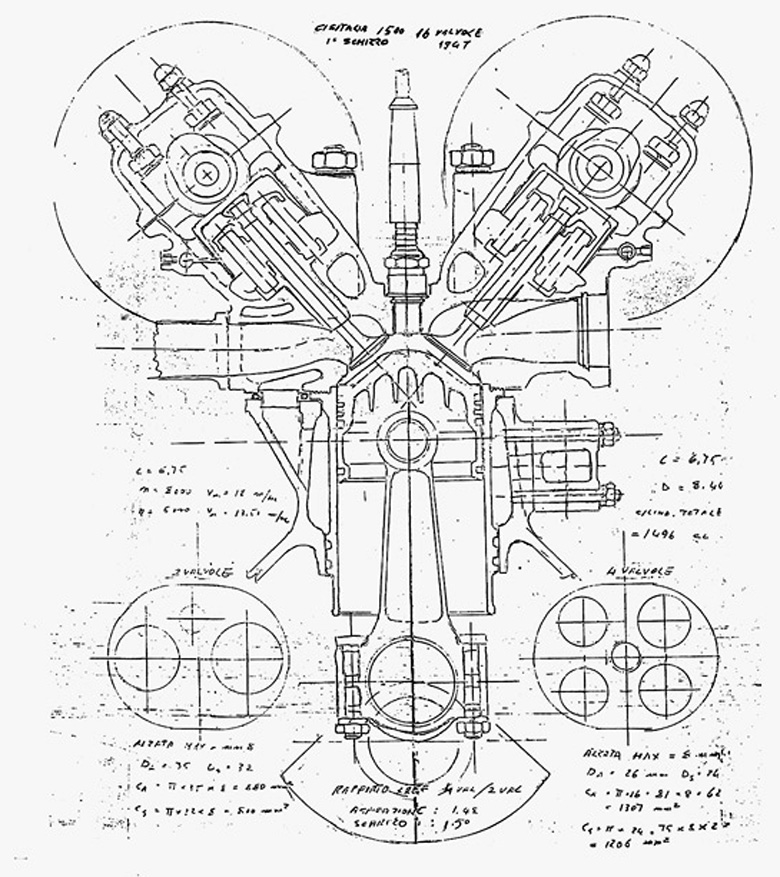
Savonuzzi’s design for a Cisitalia DOHC engine to power the second series Cisitalias.
When in 1948 Piero Dusio, Cisitalia’s owner, decided to concentrate the company’s efforts to develop a Grand Prix car, Savonuzzi left in disagreement. Believing that producing the 202 in all its subsequent versions, and for which he had developed a highly advanced 1500cc DOHC engine, would have assured the company international success, he felt that building a Grand Prix car was premature and needed designers of great expertise. “It was I”, said Savonuzzi, “who told him the only way to realize such a project would be to look for the technicians who had made the Auto Union or the Mercedes up to the end of the war, people with know-how..”. 4 To his dismay, Savonuzzi watched as Dusio began to do just that and made a contract with the engineering firm of Ferdinand Porsche after “contributing” one million French Francs paid to release him and his son-in-law from a French prison. Also, the recent execution of Savonuzzi’s partisan brother Alberto by the SS then terrorizing Ferrara, probably made it difficult for him to fathom collaborating with the Germans on any level.
The Master of Leone
From 1948 to 1949, Savonuzzi took over as Director of SVA – Societa’ Valdostana Automotori – where Savonuzzi took his talents to new heights. Full of energy and new ideas, he hooked up with an American investor to develop a Midget racer, then very popular in the U.S. While the project was highly advanced and led to several different variations including a SVA-Ermini, it finally failed for lack of financing in spite of successful racing results.
In the essential book, “La Sport i e suoi artigiani,” there is an entire chapter devoted to cars designed and developed by Giovanni Savonuzzi. But his name crops up rarely, and the title of the chapter is “Leone”. 5 Leone was only a small machinist shop that did occasional work with cars, but in 1949 it was also the workplace of Savonuzzi and Alfa wizard Virgilio Conrero, at the time his mechanic and ‘collaudatore’. The collaboration between the two, as different as any two people can be, was based on mutual professional respect and a strong sense of loyalty and the relationship prevailed throughout the years as Savonuzzi helped him with contacts and design. Easily switching gears between engineer and body designer Savonuzzi created the jet age design for the 1953 Alfa 1900 Ghia Supersonica, which entered the Mille Miglia in the hands of owner Robert Fehlman. Savonuzzi not only penned the beautiful body but designed the Alfa’s tubular frame with Lancia independent rear suspension for Conrero’s first car.
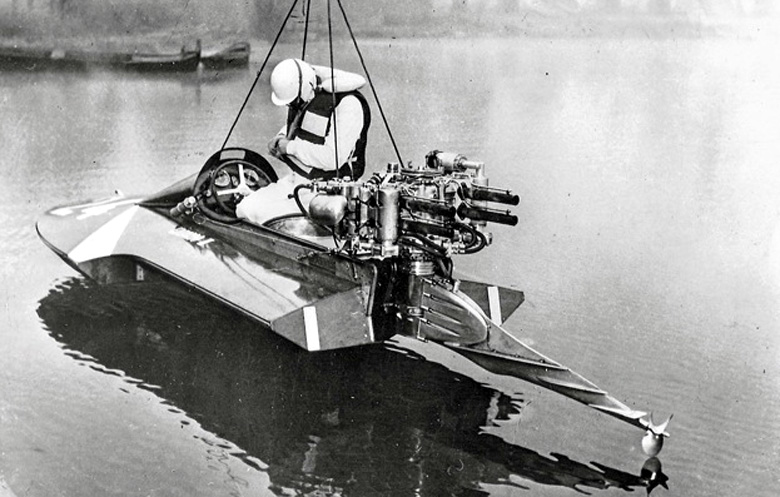
This speedboat, powered by an engine of Savonuzzi’s design and piloted by Massimo Leto di Priolo at the Idroscalo in Milan, won the world speed record.
After the demise of SVA, Savonuzzi became a free-lance consultant to Panhard, Volkswagen and Lesco among others while continuing to lecture at the Politecnico of Turin. As a testament to his versatility and boundless intellectual curiosity, during this period Savonuzzi designed an outboard motor and speedboat that, piloted by Massimo Leto di Priolo at the Idroscalo in Milan, won the world speed record. A brief stint as an outside consultant with Cisitalia resulted in the 202D model powered by the Botta & Puricelli marine motor. In 1952, he found himself back at Cisitalia, now under the control of Piero Dusio’s son Carlo.
A Return to Cisitalia
In April 1951, Savonuzzi was called by Carlo Dusio in Paris for exploratory talks with Henry Ford II that resulted in the proposed collaboration between the American colossus and Cisitalia. After the dinner, back at his hotel, Savonuzzi jotted down six pages of notes as the basis of a proposal to join forces. The idea was to build a powerful gran turismo made in Italy with a Ford motor transmission and suspensions that Savonuzzi translated into the design for the 808XF prototype. The 808 was the project number, the X stood for the X shaped backbone frame as designed by Savonuzzi, and the F for Ford. 6
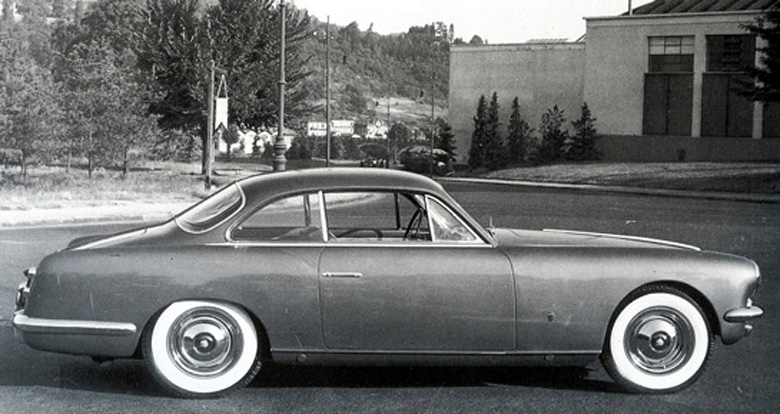
This was one of the Cisitalia 808XF prototypes. Savonuzzi not only designed the chassis but the attractive GT coachwork as well.
VeloceToday correspondent Brandes Elitch explained the Ford connection. “In the early 1950s Henry Ford II owned a Cisitalia and in 1951 he personally went to Europe and inked an agreement with Cisitalia to build cars together. Originally, the idea was to use a chassis designed by Giovanni Savonuzzi, which is interesting because most people associate Savonuzzi with styling, not engineering. The first two cars were built in 1952. In 1953, Ford agreed to finance four more prototypes, and in 1953 Vignale built a coupe and convertible.” 7 Savonuzzi created a very attractive prototype that excited the Ford personnel, but the Vignale-designed body was not going to win any awards. The project faltered, GM launched the Corvette and the Thunderbird was rushed into production, effectively killing the Cisitalia Ford project. Savonuzzi’s work on the project was virtually unknown until Urs Jacobs displayed one of the prototypes at Pebble Beach in 2008. When the deal with Ford fell through, Savonuzzi found a position as Technical Director of LMP – Lavorazione Materie Plastiche di Torino.
Part II: At Ghia and the Chrysler Turbine program
Notes
1 Interview with Giovanni Savonuzzi, Piero Casucci, Grandi Automobili 1985.
2 Forty Years of Design with Fiat, Dante Giacosa
3 Interview with Giovanni Savonuzzi, Piero Casucci, Grandi Automobili 1985.
4 Interview with Giovanni Savonuzzi, Piero Casucci, Grandi Automobili 1985.
5 La Sport I e suoi artigiani, 1937-1965, Curami, Nada
6 Cisitalia Catalogue Raisonne 1945-1965 Balestra, De Agostini, Automobilia, 1991
7 Brandes Elitch, The Ford that thought it was a Cisitalia, VeloceToday, Oct 8 2008, https://velocetoday.com/archives/1111)
Many thanks to Alberta Savonuzzi for her gracious help in providing materials and background for this article.