A Nardi, an Alfa, a Mystery

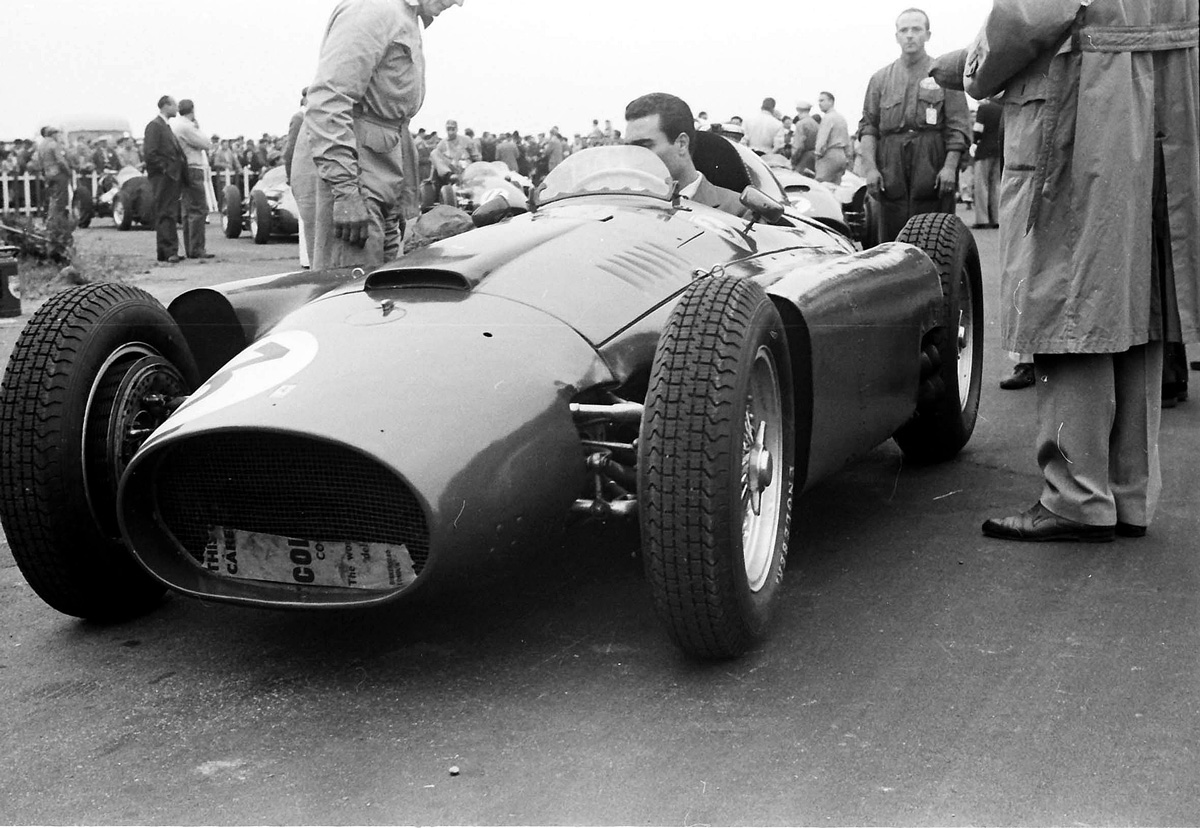
The Bonetto Alfa Romeo as rebodied by Vignale in 1951. It disappeared in 1955. Photo from ‘Alfa Romeo Milano.
This article is from the VeloceToday archives, November 21, 2103
By Pete Vack and Dino Brunori
Perhaps the mystery of the missing Alfa Romeo 412 began back in 1975 with the publication of the photo book, Alfa Romeo Milano. British journalist Michael Frostick captioned a picture of Felice Bonetto’s special-bodied Alfa Romeo thusly:
Something of a mystery. The Alfa Romeo files say “16 cylinder 4500 Mille Miglia 1954 (Bonetto).” One can only assume a car was made up with a bored-out version of the Type 162, 3 liter, 16-cylinder car, or more likely, someone has made a mistake somewhere!
Indeed there was a mystery and a mistake, as Alfa 2.9 sleuth Simon Moore realized. The Bonetto car was fairly well documented in a variety of contemporary magazines as one of the four 1939 V12 (not a V16) Tipo 412 Alfas, rebodied post war by Bonetto via Vignale. The serial number was 412151, and after it was retired from competition in 1952, it was offered to Henry Wessells III for $3200 by Franco Cortese in 1954. Henry missed the deal and the car reportedly went to Spain. But by 1955 there was no trace of the car. It had seemingly disappeared, as old race cars are wont to do.
Tracing the engine
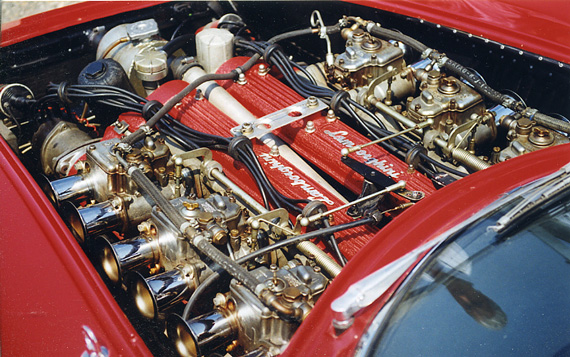
Although the Bonetto car was not specifically an Alfa 2.9, it nonetheless was part of the family and of great interest to Alfa historian Moore. By the time Moore wrote the second edition of his landmark book The Immortal 2.9 in 2008, he was on the trail of the remains of the car and the engine, but couldn’t quite pull it all together. The rare Alfa V12 engine provided the clue. It was known that the 412 engine was in the possession of Roberta Nardi, daughter of car builder Enrico Nardi. Enter Simon Kidston, working for Brooks Auctions. In mid-March of 1996, Kidston recalled for Moore, “I was contacted by Gino Macaluso, the owner of the Girard-Perregaux watch company. Roberta Nardi, whose father Enrico had left her an old Alfa Romeo engine which was languishing in the basement of her home near Turin.” Kidston recalls that Roberta didn’t know which car it had come from, but she wanted to sell it. Kidston put it up for auction in 1998, and it went to Lawrence Auriana from New York. Moore put the information in his 2008 revised edition, but the whereabouts of the body and chassis remained a mystery. [Read more…] about A Nardi, an Alfa, a Mystery
Driving the Big Ones: Napier Railton
Last week the owner of the Delage-Bequet described driving his aero-engined Grand Prix car; this week the Brooklands Museum Director, Allan Winn, takes us on a spin with the Napier W12-engined Railton, the car which conquered Brooklands for all time. We think you’ll find his words more informative and interesting than the videos, found at the end of the article. Our thanks to both for these exclusive stories Also, thanks to Paul Stewart, Brooklands Museum Marketing and PR Manager, and VeloceToday’s Jonathan Sharp
Driving Impressions by Allan Winn, Brooklands Museum Director
First off, the Napier-Railton is an enormously powerful, iconic machine. However, the overwhelming impression you have from driving it on a regular basis is how benign and user-friendly it is. That’s not to say it is an easy car to start or drive, but it is an extraordinary, well-behaved machine.
Starting
Starting the Napier requires concentration. There is nothing like a choke. The first thing you have to do is to turn the fuel on, then pump the Ki-Gas about eight times, which squirts neat fuel into the inlet manifolds. There is an enormously long distance from the triple carb throats to the rearmost pistons. Then, you need to lock the Ki-gas pump on the dashboard so the handle does not come loose.
Then it’s a case of rocking the car to get it into first gear on the three-speed gearbox, switching on the two magnetos (with what looks a lot like a Victorian electrical house switch), then releasing the fly-off handbrake and getting up to four people to push furiously up to a walking pace. Finally, drop the clutch – after alerting the pushers – and it will fire on the first or second compression.
As soon as it picks up to 12 cylinders, you knock it into neutral, then stop and check that the oil pressure is up to 65 psi and that you haven’t had a spitback through the carbs and you don’t have a fire burning in the inlets. (If it did, any fire should get sucked right back into the carbs and you wouldn’t have a problem.)
Warm up procedure
One must bear in mind that the “broad arrow” Lion W12 is huge, and requires 52 liters of coolant and around 15 gallons (not quarts) of Castrol GP 50. Warming up means bringing the coolant up to about 70 degrees C which can take up to ten minutes. We run it at about 1,000 rpm for first couple of minutes then bring it up to 1,100-1,200 rpm to hasten the process. We are using a waterless vintage coolant which has very good non-corrosive and wetting qualities and keeps the car running much cooler than it did on a water/antifreeze mix. In normal running it’s extremely difficult to get any reading at all on the oil temp gauge.
The Napier W-12.
Beatle’s Cars Star at NEC

George Harrison's Dino 246 GTS. George purchased the car in the early 1970s from Rodney Turner. George owned the car for 4 years
Story and Photos by Jonathan Sharp
Variety is very important when running a very well-established show. This year’s Classic Car show at the NEC in Birmingham was the 30th running and was probably the largest yet, with over 65,000 people attending over the three days, and the hundreds of cars and bikes being spread out over 11 halls. As the show attracts mainly car clubs as well as exhibitors, amazingly, each year the clubs bring out more cars you hardly ever see, if at all. And while perhaps this year’s content was a bit down on exotics, it certainly made up for it with rare, offbeat, and unusual items.
When was the last time you cast eyes on a Renault 30 from the early 80s, a Lancia Trevi, or a Fiat Uno Selecta? (By the way, the Fiat Uno also celebrates its 30th anniversary this year.) Another nice feature of the show is the grouping of the cars; the Italian car clubs are together in one area, the French cars together in another area. You only need to find the appropriate hall and see cars that are of particular interest to you; no need to trudge around 11 halls to find them all. But that would be a shame, because if variety is important, you may just miss something that you had never seen before, even if it was out of your normal sphere of interest.
The Beatles car display added interest, but the display area for the four cars was very small, which is why my shots do not show the whole car; too many ropes in the way. They did however, paint what we in the UK call a “Zebra Crossing” leading up to the display area, similar to the famous Abbey Road Album cover.

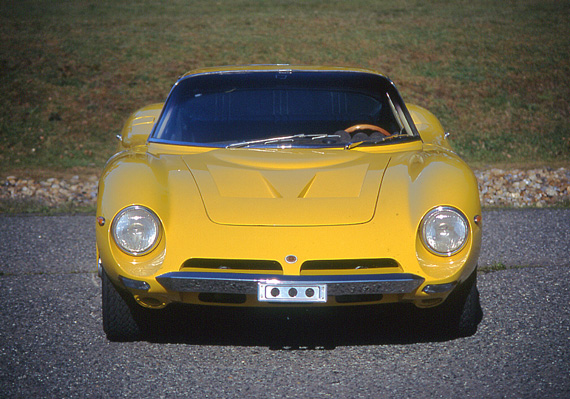
John Lennon's Iso Fidia. It is believed that John owned three Fidias during his lifetime. This was number two. The car was originally silver with a blue leather interior.
Paul McCartney's Aston Martin DB6.
Our Features This Week, November 14, 2013

Mott on Manney. Graham Gauld’s article last week on Henry Manney III elicited a special email from the talented artist Stan Mott, who also worked with Manney. Mott is responsible for the humorous and imaginative Cyclops and Pignatelli (art) that appeared in Road & Track and Sports Cars Illustrated. He drew this impression of Manney back in the days when journalists were journalists. It is too small to be appreciated above, so simply click on the artwork and it will appear much larger so that you can read the cartoon’s wording, which you’ll no doubt find hilarious. Published with permission of Stan Mott.
Driving the Big Ones: Delage Bequet Hispano Suiza

The Delage Bequet at Kop Hill, 2013. This car was originally built as a 2 liter V12. The car was rebuilt for Maurice Bequet and was fitted with a 12 Liter Hispano Suiza V8 aero engine in 1926. The runs are not timed but this did not seem to deter Boswell's spirited run. Jonathan Sharp photo.
Those who have ridden as co-pilot say that a desire to survive is their dominant emotion.
By Alexander Boswell, owner, driver
It’s an amazing experience to drive any car built for Grand Prix racing. One knows that relentless effort, concentration of resources, and usually a huge budget have contributed to the creation of something technologically remarkable. Despite its 90th anniversary, the 2LCV Delage still encapsulates all these elements. In 1923 this was the only entry from the stable of the Delage company, and therefore it represents the pinnacle of the technology of the time. This car was driven in the French GP by René Thomas, the Sebastian Vettel of his day.
The Delage was raced in 1923 with the world’s first V-12 racing engine. At 2 liters capacity, each piston was no bigger than an eggcup. It was a complex engine, and by our standards today, only moderately powered.
That’s why the addition of a 12 liter Hispano Suiza out of a SPAD fighter in 1925 created such a sensational machine. The brilliance of the finest 1923 racing chassis was mated to the effortless power of a big low-revving engine. This was former test-pilot Maurice Bequet’s inspiration….and it’s still causing a sensation to this day.
The car is delicate in every way apart from the motor. Once those great pistons start moving and the twin-plug ignition fires the mixture, the beast is dominated by the engine. Smoke and flames emerge from the stub exhausts, and the noise is a sharp low bark. In the cockpit the engine feels frighteningly alive. Let out the clutch and the narrow wheels spin uncontrollably. In first gear it’s doing 30mph whilst the engine runs at idle. Second gear is good for nearly 100; third is geared at 65mph per 1000rpm, and over 150 mph is possible. [Read more…] about Driving the Big Ones: Delage Bequet Hispano SuizaLondon to Brighton and the Classics of Regent Street
In our twelve years of publishing weekly, VeloceToday has never covered the London to Brighton Run. Yet it is the oldest vintage car event in the world, usually dominated by French cars. In the last four years the start in London is augmented by what is billed as the ‘largest free motor show in the U.K.,’ the Regent Street Motor Show. This year, Jonathan Sharp reports on the activities from both London and his hometown of Brighton. See also “Brighton in Photos” (link) for Sharp’s excellent Vintage photos. Remember to click on photos to see larger image!
Story and photos by Jonathan Sharp
Be sure to click on the photos to see much larger images!
Regent Street Motor Show
Early Christmas shoppers had a pleasant surprise when they went down to London’s famous Regent Street on the morning of Saturday the 2nd November. Gone were the red buses and black cabs that normally haunt the glamorous shopping street, replaced by a small lineup of Porsche 911s, there to celebrate their 50th Anniversary, a much larger line up of Aston Martins of all ages there to celebrate their 100th Anniversary, and an even larger line up of Veteran Cars there to celebrate the 117th running of the London to Brighton Veteran Car Run.
Billed as the largest free motor show in the UK, the display is called the Regent Street Motor Show and is now in its fourth year. The Aston Martin line up was a good cross section of David Brown models and later V8 models, Saloons, Vantages and Volantes, brought right up to date with many current examples. From a photographer’s standpoint they had been roped off, which made photography a lot easier. Alas, that was not the case with the Veteran cars which proved very popular with the crowds, so patience was called for when taking shots. I am grateful to the sales assistants in the Jaeger store for allowing me to photograph the racing Napiers from the second floor windows of the ladies wear department, and to the Westminster City Council for positioning street lamps along the middle of the street (which gave me something to climb up!)

Getting the high view. Note the crowd on Regent Street, which seemed very interested in learning more about these Veterans.(Click to enlarge)
Three important Napiers [Read more…] about London to Brighton and the Classics of Regent Street
Brighton Run 2013 in Photos by Jonathan Sharp

1898 Peugeot Double Phaeton Type 15 owned and driven by Mr. Colin Clarke. Between 1897 and 1900 Peugeot built 182 Type 15s. This example left the factory on the 16th July 1898. The Type 15 was fitted with the first engine ever built by Peugeot, a horizontal two-cylinder engine with 6 hp allied to a four-speed gearbox and twin-chain drive. One of the Type 15s was sold to Charles Rolls of Rolls-Royce fame. This example is fitted with a Double Phaeton body and still runs on its original hot tube ignition. The chassis tubes form part of the cooling system. The car has a top speed of 25 mph. (Click to enlarge)
Jonathan Sharp highlights the Brighton to London Run in photos. Be sure to read his story, London to Brighton, also in this edition of VeloceToday. Also, click on each photo to see much larger images!

1902 single-cylinder 8 hp Deckert, owned and driven by Mrs. Barbara Dedman. The Deckert company was founded in Paris in the early 1900s by Henri Deckert. They built motor cycles, motor tricycles and motor cars. To promote his company Henri entered his vehicles in various trails but without success. The company folded in 1906. This is the only surviving example and is a regular entrant in the London to Brighton run. Aurore means dawn. The wheel depicts the rising sun and the bird heralds the dawn of the age of the motor car. (Click to enlarge)

1903 4-cylinder 7700cc 50 hp Napier, the oldest surviving complete British Racing car. The car was driven by Charles Jarrott in the 1903 Gordon Bennett race. Now owned by the National Motor Museum Beaulieu. (Click to enlarge)
[Read more…] about Brighton Run 2013 in Photos by Jonathan Sharp
Best of France and Italy, 2013

Vintage Alfa racer owned by Brandon Adrian. The full history of this time capsule was on the placard.
Story and photos by Richard Bartholomew
November 3, 2013
Woodley Park is a vast green expanse of grass near a large earthen dam that is part of the water control system that brought water to parched Los Angeles in the 1920s. There are frequent car shows there but for lovers of Italian and French cars this is one of the best.
Why? First because it’s free and second because it brings out lots of cars that aren’t spiffy enough to be in a concours but still damned interesting. Cars on their way to glory, one might say.
In the French category, there were Simcas, Citroens, Renaults (including two Caravelle convertibles which are surprisingly elegant cars considering they sold new for under $3000) Facel Vegas from the magnificent Facel II to the Facellias, a Matra Djet, a half dozen Renault Turbo I and Turbo II pocket rockets.
But most of the French cars seemed postwar, in contrast to this event in the past, when there were half a dozen prewar cars. (Could it be the prewar cars are now too nicely restored to show?) Oddly, right in the middle of the French offerings was a Packard which they said was bodied by Kellner, but except for a sharp crease in the rear fenders and a very rakish second windscreen, we couldn’t see much Euro influence.
Delightful, imaginative, and probably stock color scheme for this 2CV.
Our Features This Week, November 7, 2013
Henry Manney and the 52 Million Dollar GTO
It’s funny how news reports remind you of old departed friends. A recent news report on the $52 million sale of Ferrari GTO 5111GT brought back a score of happy memories of times spent with American motoring journalist and raconteur Henry Manney III.
Henry Manney III may not be a familiar name to a modern generation, but back in the 1960s he not only sprung to prominence with his witty and amusing articles in Road & Track magazine but he actually created what we would call the modern “loose” form of writing about cars. He dispensed with the turgid prose of the regular motoring writers of the day and replaced it with colorful turns of phrase; even inventing his own words to express his feelings and mood. [Read more…] about Henry Manney and the 52 Million Dollar GTO